Why Specs Can Be Misleading at First Glance
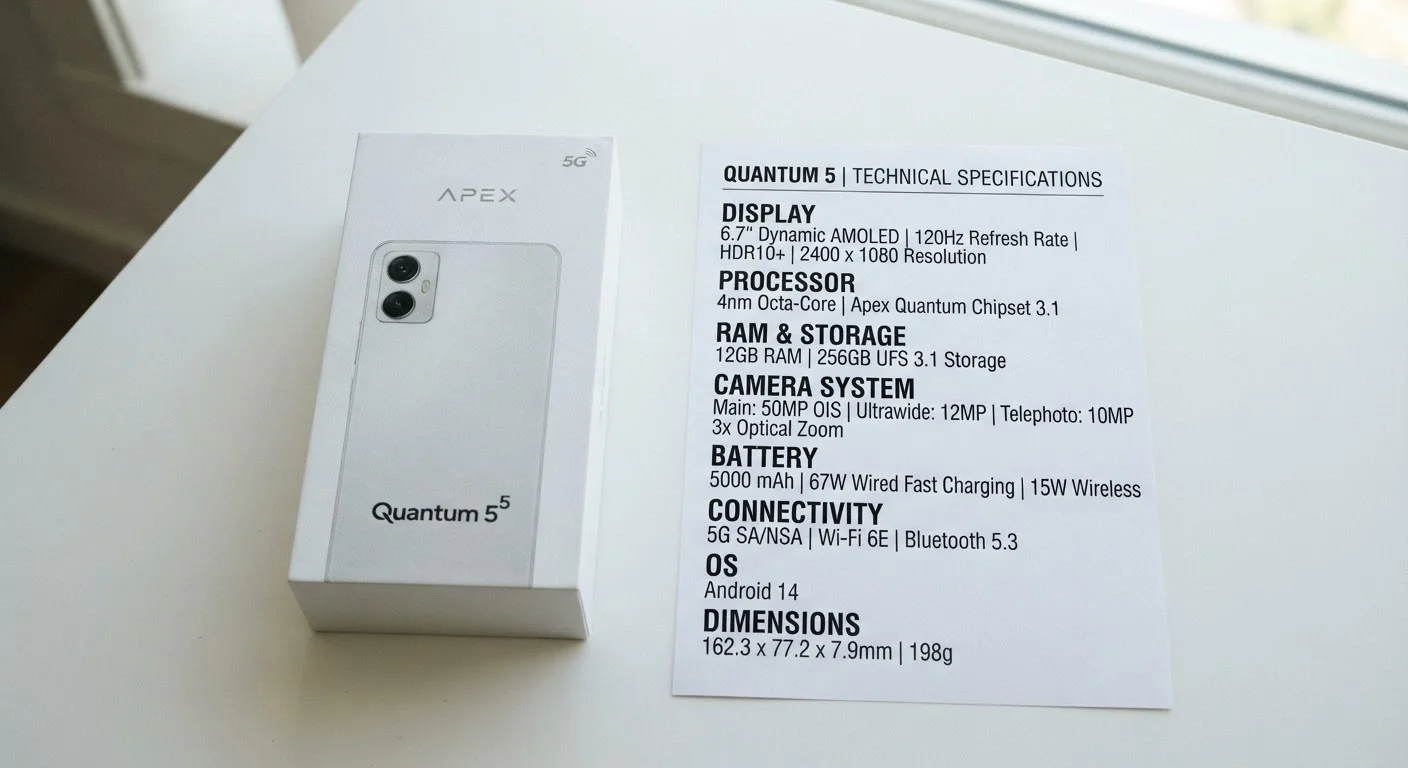
Walk into any electronics section and you'll see phones advertised with numbers that sound impressive but reveal little without context: "12 GB RAM," "3.2 GHz," "5000 mAh." Manufacturers have every incentive to highlight whichever numbers look largest on a label. The result is that many shoppers end up either overpaying for capabilities they'll never use or dismissing phones that would actually serve them well.
The goal here isn't to memorize every spec — it's to understand what each one does in your hand, on a typical day. That shift in perspective changes how you read a product page. See our guide on why high spec sheets don't always mean a better experience for a broader look at this principle across devices.
6–8 GB
RAM sufficient for most everyday smartphone users
Industry analysis consistently shows diminishing real-world returns beyond this range for typical tasks like browsing, messaging, and social media.
800+ nits
Display brightness needed for comfortable outdoor viewing
Display testing organizations use this threshold as a general benchmark for usability in direct sunlight conditions.
120 Hz
Refresh rate where scrolling smoothness becomes noticeable
User perception studies indicate that the jump from 60 Hz to 120 Hz is more apparent to most people than increases beyond 120 Hz.
RAM and Processor Speed: The Multitasking Engine
RAM (Random Access Memory) is your phone's short-term workspace. It holds the apps and data currently in use so the phone doesn't have to reload them from storage constantly. More RAM means more apps can stay "warm" in the background — useful if you switch frequently between a browser, a navigation app, and a messaging thread. It does not make any single app run faster on its own.
Processor clock speed, measured in GHz, tells you how many processing cycles the chip completes each second. But comparing GHz numbers across different chip families is like comparing engine displacement across completely different vehicle types — the relationship to real-world performance is indirect at best. What matters more is the chip's generation and architecture. Learn how processor chips shape gaming and battery life for a deeper look at why chip design outweighs raw clock speed. For a parallel explanation covering laptops and computers, see RAM, storage, and processing speed explained.
Match Specs to Your Actual Usage Patterns
Before comparing numbers, list the three to five things you do most on your phone. If your list includes streaming video, light social media, and navigation, you need competent but not extreme specs in most categories. If it includes mobile gaming or video editing, processor and RAM become more critical. Grounding your spec review in real tasks prevents paying for capabilities you'll never exercise.
Display Brightness, Resolution, and Refresh Rate
Three display specs come up repeatedly, and each addresses a different aspect of what you see:
- Nits measure peak brightness. Anything above roughly 800 nits handles direct sunlight reasonably well; below 500 nits, outdoor visibility becomes a real frustration.
- Resolution (expressed as pixel dimensions like 2400×1080) determines sharpness. On a phone screen smaller than 7 inches, most people cannot distinguish individual pixels above a certain density — so chasing maximum resolution often provides no perceptible benefit.
- Refresh rate, measured in Hz, controls how many times per second the display updates. A 120 Hz screen feels noticeably smoother for scrolling and gaming compared to 60 Hz, but it also draws more power. Some phones apply variable refresh rates to balance smoothness with battery life.
Storage, Battery, and Connectivity Numbers
Storage capacity (GB or TB) tells you how much content fits on the phone. But storage also has a speed dimension — measured by read/write rates — that affects how fast apps launch and files transfer. Manufacturers rarely advertise storage speed prominently, even though it meaningfully affects daily responsiveness.
Battery capacity in mAh sets an upper limit on how much energy is stored, but the chip's power consumption and the display's brightness profile determine how long that energy actually lasts. A 5000 mAh battery paired with an efficient modern chip will typically outlast a 4500 mAh battery running older, less efficient silicon.
Connectivity specs — 5G, LTE, Wi-Fi standards — determine how your phone communicates with networks and routers. These matter in specific contexts. Understand the real difference between 5G, LTE, and Wi-Fi calling before assuming 5G support alone justifies a price premium.
Camera Specs: What to Look Past the Megapixels
Camera specifications deserve special attention because marketing copy leans heavily on megapixel counts, which are among the least predictive numbers for actual photo quality. Megapixels measure resolution — how much detail is captured — but image quality also depends on the physical sensor size, the aperture (how much light the lens allows in), and the phone's computational photography software.
A larger sensor captures more light per pixel, which directly benefits low-light photography. A wider aperture (a smaller f-number like f/1.8 versus f/2.4) also improves light intake. For a full breakdown of what each camera spec actually affects, see every camera spec on a smartphone explained without the marketing spin.
If you're approaching your first purchase and want to avoid common missteps beyond spec interpretation, things first-time smartphone buyers consistently get wrong covers the broader decision-making pitfalls. And for a comprehensive end-to-end view, the smartphones and tablets guide for everyday buyers ties all of these elements together.
Specs Don't Capture Software Support
One major factor absent from any spec sheet is how long the manufacturer commits to delivering operating system updates and security patches. A phone with modest hardware that receives updates for five or six years may serve you better long-term than a high-spec model abandoned after two years. Always check the manufacturer's stated support timeline alongside the hardware numbers.