Why Organization Feels So Hard at First
If your home feels perpetually chaotic despite your best intentions, you're not alone — and it's not a character flaw. Most people were never taught a systematic approach to managing their physical space. Organization isn't an innate talent; it's a learned skill, and like any skill, it gets easier with practice and the right framework.
The psychological weight of a cluttered environment is real. Research in environmental psychology suggests that visual clutter competes for attention and can contribute to elevated stress. But understanding why disorganization happens is the first step toward addressing it — and it almost always comes down to the same few culprits: items without designated homes, too much stuff for the available space, and habits that haven't caught up with intentions.
The good news is that you don't need to overhaul your entire home in a single weekend. That approach tends to lead to burnout. Instead, this guide will show you how to build a calm, functional space one section at a time. You might also find it useful to question some common beliefs about decluttering before you begin — several widespread assumptions actively work against progress.
Core Principles Every Beginner Should Know
Before touching a single drawer, it helps to understand the principles that make organization work — not just for a week, but long-term.
Decluttering
The process of deciding which items to keep and which to remove from your home — it happens before organizing, not during it.
Designated home
A specific, consistent location assigned to a category of items so they always return to the same spot after use.
Category sorting
Grouping similar items together (all batteries, all cleaning sprays) so you can see the full quantity before deciding what to keep.
Maintenance habit
A short, repeatable daily action — like a five-minute tidy — that keeps a space organized without requiring a full reorganization session.
Decision fatigue
The mental exhaustion that comes from making too many choices in a row, which is why tackling smaller spaces in shorter sessions tends to produce better decisions.
Declutter Before You Organize
Organizing clutter just means neatly storing things you don't need. The sequence matters: decide what stays, then find a home for it. Skipping this step is why many people organize the same items repeatedly without ever feeling like their space improves.
Every Item Needs a Home
When objects don't have a designated place, they pile up wherever they land. Assigning a specific location to every category of item — mail, keys, cleaning supplies — transforms cleanup from a guessing game into a simple action.
Match Systems to Your Real Life
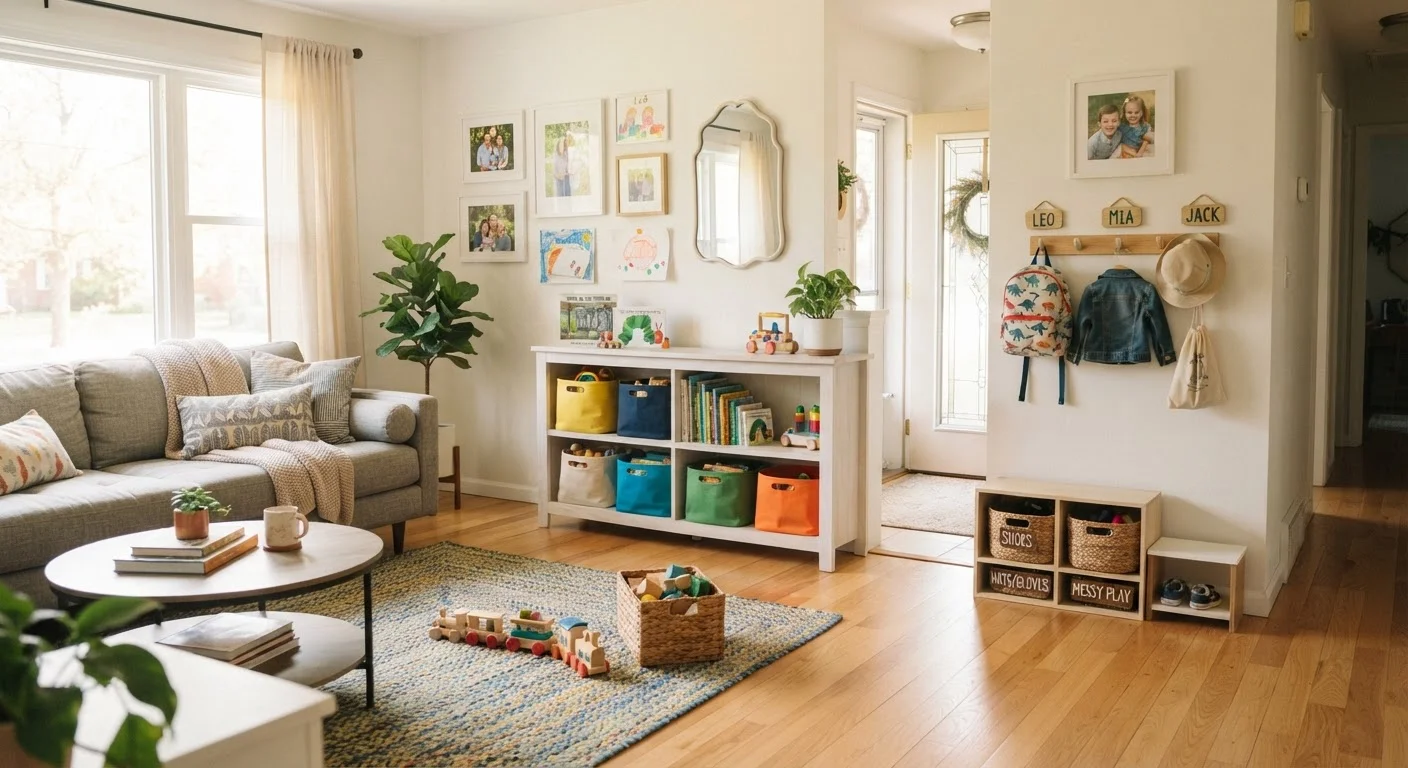
The most elegant storage solution fails if it doesn't reflect how you actually live. If you tend to drop your bag at the door, that's where your bag's home should be — not in a closet across the house. Work with your natural tendencies, not against them.
Where to Start: Your First Room
Choosing a starting point strategically matters. Avoid beginning with the most overwhelming space — the garage, a packed spare room, or anywhere with deep sentimental items. Instead, pick a small, high-traffic area where visible improvement will happen quickly.
Good first spaces include a bathroom cabinet, an entryway, or a kitchen counter. These have a limited range of item types, which reduces the number of decisions you need to make. Work through this sequence in your chosen space:
- Empty the space completely. This forces you to confront everything in it, rather than shuffling items around.
- Sort into categories. Group like items together so you can see what you actually have.
- Decide what stays. Remove anything broken, expired, or genuinely unused.
- Assign homes before returning items. Think about frequency of use — daily items should be most accessible.
- Only then consider containers. Measure before purchasing anything.
Once you've completed one space, use that momentum to move forward. Our room-by-room organization walkthrough covers every area of the home in depth when you're ready to expand.
Photograph Your Space Before You Start
Take a quick photo of the area before you begin organizing. When you finish, compare the two images side by side. Seeing concrete visual progress is one of the most effective motivators for continuing to the next space — especially on days when the effort feels thankless.
Building Habits That Actually Stick
Organization isn't a project you finish — it's a practice you maintain. The spaces that stay tidy long-term aren't maintained by discipline alone; they're supported by small, repeatable habits embedded into daily routines.
A few habits worth establishing early:
- One-touch rule: When you pick something up, put it where it belongs — not on a nearby surface to deal with later.
- Daily reset: A five-minute tidy at the end of each day prevents the gradual accumulation that leads to overwhelm.
- One-in, one-out: When something new enters your home, something comparable leaves. Understanding why this rule works can help you apply it more consistently.
These micro-habits are low effort individually but compound significantly over time. Think of them less as rules and more as the infrastructure that keeps your system running without constant intervention.
Common Mistakes and How to Avoid Them
Even well-intentioned beginners tend to hit the same walls. Knowing these in advance can save you considerable time and frustration.
Don't Skip the Declutter Step
It can be tempting to jump straight to containers and labels because it feels productive immediately. But organizing without first removing what you don't need means you're just rearranging the problem. Take time to sort and edit before you reach for a single storage bin.
Buying Storage Too Soon
Purchasing bins, baskets, and drawer dividers before decluttering is one of the most common early mistakes. You end up organizing clutter into containers, which looks tidier but doesn't solve the underlying problem. Always declutter first.
Trying to Do Everything at Once
Attempting a whole-home overhaul in a single session almost always ends in burnout and abandoned projects mid-process. Contained, focused sessions — even 30 minutes — are more productive and sustainable.
Creating Systems That Are Too Complex
If a system requires significant effort to maintain, it won't be maintained. The goal is a setup that's easy enough to use on a tired Tuesday evening. Simplicity is a feature, not a limitation.
If you find your progress stalling after an initial push, you're not unusual. Our article on where organization efforts tend to break down identifies the most common points of failure and what to do about them.