Why Most Organizing Systems Fall Apart With Kids Around
Family organization fails not because parents aren't trying, but because most systems are designed for adults living in adult-paced households. Children move fast, follow convenience over instruction, and change their habits as they grow. A system that ignores those realities will collapse within weeks.
The strategies below are built around a different premise: make the right choice the easy choice. If a bin is labeled, within reach, and wide enough to toss things into quickly, kids are far more likely to use it. If the system requires perfect placement or a multi-step process, it won't survive a Tuesday afternoon.
For readers new to home organization altogether, the beginner's guide to home organization is a practical place to start before layering in family-specific strategies.
Use open bins at kid height in every main room
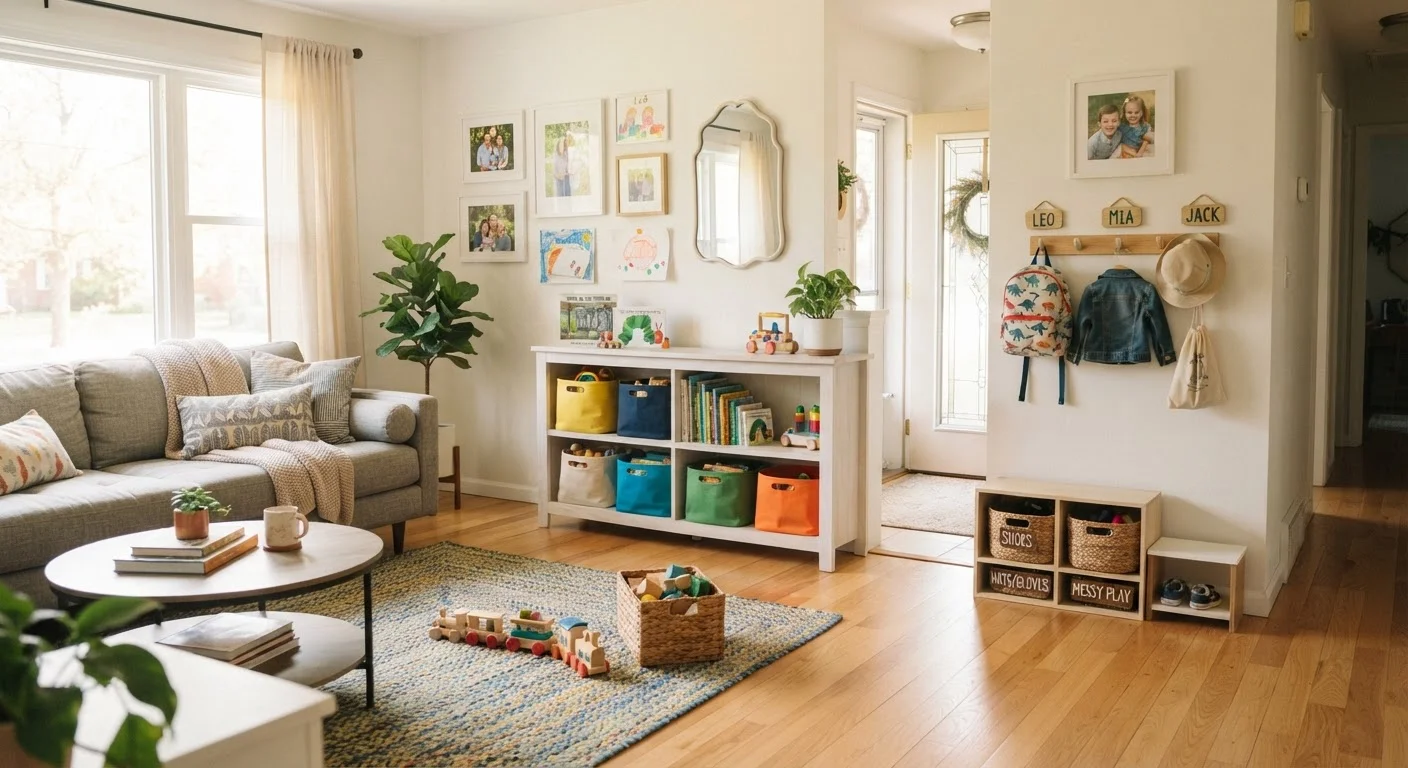
Lids are the enemy of kid-maintained organization. Open-top bins placed at a child's natural reach level remove every friction point between picking something up and putting it away. In living rooms, this means floor-level baskets for toys and books. In bedrooms, low shelving with open compartments beats a dresser with drawers that require effort to open and close.
The fewer steps between a child and the storage spot, the better the odds that items actually get returned. Match bin size to category — one large bin for stuffed animals, one for building blocks — rather than trying to sort items too finely.
Open-top bins at kid level eliminate every excuse not to put things away.
Label with pictures for younger children, words for older ones
Written labels work well for school-age kids, but for children who aren't reading fluently yet, picture labels — a photo or simple drawing of the contents — make the system truly independent. You can print photos of the actual items that belong in each bin and tape them to the front.
This approach also reduces the number of times a parent has to answer "where does this go?" Picture labels communicate the expectation without requiring a conversation. As kids grow, transition to written labels, which encourages reading and reinforces the system in a new way.
Picture labels let young children use storage systems completely on their own.
Create a dedicated drop zone at every entry point
Backpacks, shoes, jackets, and sports equipment don't make it to their "proper" storage locations because children drop things the moment they walk in. Work with that behavior rather than against it by creating an intentional drop zone — hooks at child height, a shoe tray, and a small shelf or cubby for bags — right at the entry point.
A drop zone doesn't have to be elaborate. Even a row of hooks at the right height with labeled pegs per child creates enough structure to keep entryways functional. If your home has a garage entry, a mudroom-style setup there is often more realistic than expecting items to travel further into the house.
Meeting kids where they stop — at the door — prevents clutter from spreading.
Apply a zone-based approach to shared spaces
Shared family rooms benefit from zone-based organization — dividing the space by activity type rather than by item category. A reading zone, a building or craft zone, and a screen or game zone each have their own designated storage. This reduces conflict over space and makes cleanup instructions simpler: "put everything back in its zone."
If you want to think through whether zone-based or category-based systems work better for your household overall, the comparison of zoning vs. category organization walks through both approaches clearly.
Zone-based rooms give kids a simple cleanup rule they can actually follow.
Rotate toys and supplies to reduce active clutter
Most families have more toys and art supplies than any child plays with at a given time. Rotation — storing a portion of items out of reach and swapping them in every few weeks — keeps active clutter manageable without requiring the family to own less. Children often engage more enthusiastically with items that reappear after a break.
A simple approach: divide toys into two or three groups and store inactive groups in labeled bins in a closet or under a bed. Rotate on a regular schedule, or simply when you notice engagement dropping. The closet organization methods that hold up over time covers practical ways to use closet space effectively for storage like this.
Rotating toys reduces visible clutter and often reignites children's interest in what they own.
Build a short daily reset into the routine — not a deep clean
Family spaces don't stay organized through periodic major overhauls. They stay manageable through brief, consistent resets — 10 to 15 minutes at a consistent time each day, typically before or after dinner. Each person, including children old enough to participate, is responsible for their own reset zone.
Framing this as a shared household habit rather than a chore assigned to one parent distributes the load and builds children's sense of ownership over shared spaces. Keep expectations proportional to age: a toddler putting three things in a bin is a success. Consistency over time matters far more than perfection in any single session.
A daily 10-minute reset beats a weekly overhaul every time.
Building Systems That Reset Easily
No organization system survives contact with family life perfectly — the goal is to make recovery fast. A good family system can be reset to functional in 10 to 15 minutes, not hours. That's only possible when everything has a clearly defined, reachable home.
Start with one room, not the whole house
Trying to implement a new organization system in every room simultaneously overwhelms both parents and kids. Choose the space that causes the most daily friction — often the entryway or the living room — and build one working system there first. Once it becomes habit, expand. A single successful room demonstrates the approach and builds confidence before you scale it.
For a thorough room-by-room breakdown beyond what's covered here, the complete room-by-room organization walkthrough offers detailed methods for every space in the home. And if you find your organized spaces sliding back into chaos over time, common reasons home organization breaks down identifies the specific patterns to watch for.