The Real Cost Comparison
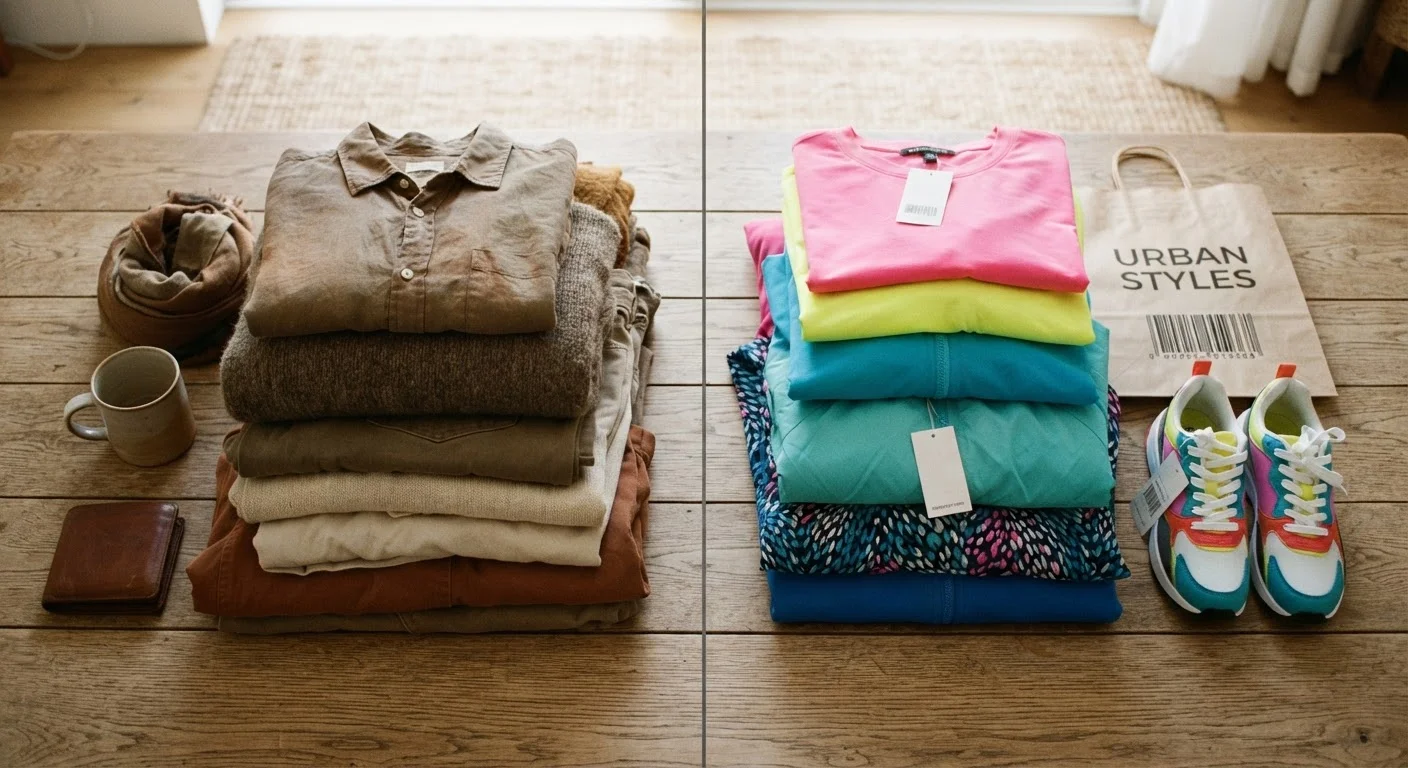
Price tags tell only part of the story. A fast-fashion top might cost $15 to $30 at a chain retailer, while a comparable piece at a thrift store might run $3 to $8. On the surface, thrifting wins on sticker price — but factor in the time it takes to find that piece, and the equation gets more complicated.
Thrift shopping is inherently unpredictable. You might walk in looking for a navy blazer and leave with nothing — or spend two hours to find exactly what you needed. Fast fashion delivers consistency: you can search online by size, color, and style and have something at your door within days. For people with demanding schedules, that time difference has real value.
It's also worth thinking about cost-per-wear. A $12 fast-fashion dress worn twice before it loses its shape costs more per use than a $6 thrifted dress worn thirty times. Quality of construction — not the shopping channel — usually determines longevity. And thrift stores do carry well-made, older garments that were built to last. Building a wardrobe on a tight budget means thinking in cost-per-wear, not just sticker price.
| Criterion | Thrifting | Fast Fashion |
|---|---|---|
| Average item cost | Low ($3–$10 typical) | Low–mid ($10–$40 typical) |
| Time to find an item | Unpredictable; can be hours | Fast; minutes online |
| Sizing consistency | Variable across brands/eras | Consistent within retailer |
| Item availability | One-of-a-kind, no restocking | Stocked inventory, restockable |
| Construction quality range | Wide — worn basics to durable classics | Typically lower; varies by retailer |
| Environmental footprint | Lower (extends garment life) | Higher (new production, high turnover) |
| Trend alignment | Hit-or-miss; cyclical finds | On-trend by design |
Environmental Impact: What the Research Suggests
The fashion industry's environmental footprint is a subject of ongoing research and debate, but some findings are well-established. Producing a new garment uses water, energy, and raw materials — a single cotton T-shirt is estimated to require significant water to produce, according to lifecycle assessments published by organizations including the Ellen MacArthur Foundation.
Thrifting extends the usable life of a garment that already exists, which generally means fewer new resources consumed. That said, thrifting isn't without its own footprint — donated items that don't sell often end up in landfills or are shipped overseas, processes that carry their own environmental costs.
Fast fashion's model — high volume, low cost, rapid trend cycles — is associated with higher rates of garment disposal. Shoppers who treat low-cost clothing as disposable contribute to that cycle, whether intentionally or not. Slowing that cycle, even by buying secondhand for some purchases, is a meaningful lever individuals can pull. For more on making intentional wardrobe decisions, why "buy less, choose well" is harder than it sounds is worth a read.
~2,700 L
Water to produce one cotton T-shirt
Lifecycle assessments cited by the Ellen MacArthur Foundation estimate a single cotton T-shirt requires roughly 2,700 liters of water to produce.
92M tons
Textile waste generated globally per year
The UN Environment Programme estimates the fashion industry generates approximately 92 million tons of textile waste annually.
~3x longer
Lifespan extension from secondhand shopping
Research from WRAP (Waste & Resources Action Programme) found that extending a garment's active life by nine months reduced its environmental impact measurably.
Quality, Fit, and the Luck Factor
One underappreciated truth: fit matters more than where you bought something. A well-fitting thrifted piece will always look more polished than an ill-fitting new one. Fit is everything when it comes to how clothes look — and that holds whether you paid $4 or $40.
Fast fashion offers the advantage of consistent sizing across a collection, which makes online shopping more predictable. Thrift stores, by contrast, carry clothing from dozens of brands and eras, each with different sizing conventions. What's labeled a medium might fit like a small or a large. Trying things on — or buying from thrift platforms with good return policies — helps manage that variability.
Quality at thrift stores runs the full spectrum. Alongside worn-out basics, you'll find heavy-knit sweaters, structured blazers, and denim from decades when garment construction was more durable. The key skill is learning to inspect construction: check seam allowances, fabric weight, and stitching quality before buying. That's a learnable habit that pays off over time. Once you've assembled a solid foundation, balancing neutral and statement pieces helps every outfit work harder.
Thrift Store Quality Varies Widely
Not every thrift store is equal — inventory quality depends heavily on the donation base of the surrounding area and how items are sorted. Higher-end consignment shops curate more carefully but charge more; traditional charity thrift stores are less curated but cheaper. Online resale platforms often include condition ratings and seller photos, which can reduce the guesswork before you commit to a purchase.
Making the Choice That Works for Your Life
Most people don't live entirely in one camp. A practical middle ground looks like this: thrift for items where selection doesn't matter much (basics, layering pieces, home-workout clothes), and buy new for items where fit precision or specific function matters (undergarments, athletic shoes, workwear with strict dress codes).
If you're curious about thrifting but don't know where to start, apps and online resale platforms have reduced the time barrier significantly — you can filter by size, color, and condition without leaving your couch. If fast fashion is your current default, being more intentional about what you buy — and buying less of it — can meaningfully shift your cost-per-wear and wardrobe quality. Shopping your own closet first is always the most budget-friendly move before heading to any store.
The goal isn't moral purity — it's a wardrobe that serves you well without draining your time, money, or the planet more than necessary. Both approaches, used thoughtfully, can get you there.