The Science Behind Why Space Matters for Hamsters
Hamsters are often marketed as a low-effort starter pet, but that reputation obscures a biological reality: these small animals have complex spatial needs rooted in wild behavior. Syrian hamsters in their native habitat — the arid regions of Syria and Turkey — have been documented traveling up to 5–8 miles per night in search of food and mates. Dwarf species follow similar patterns at a smaller scale. This is not incidental behavior; it reflects deep neurological and physical wiring.
Research published in peer-reviewed animal behavior journals has demonstrated that hamsters housed in undersized enclosures display significantly elevated stress indicators, including increased stereotypic behavior (repetitive, purposeless movements), disrupted sleep cycles, and altered stress-hormone profiles. These are not signs of a quirky personality — they are measurable welfare deficits.
Common misconceptions about small pets often lead owners to underestimate these needs. Understanding the science is the first step toward correcting the setup. See also our guide on reading your small pet's body language to identify stress signals early.
Choosing a cage based on price or appearance rather than floor space dimensions.
Why it happens: Pet store cages are often packaged and marketed as appropriate for hamsters without disclosing that they fall below welfare-informed minimums. Owners trust the labeling.
Providing substrate that is too shallow to allow burrowing.
Why it happens: Many owners add a thin layer of bedding for odor control without realizing that burrowing is a behavioral need, not just a comfort preference.
Using a wheel that is too small or has a mesh surface.
Why it happens: Small colorful wheels are prominently displayed in pet stores and appear appropriately sized for a small animal. The injury and posture risks are not obvious from the packaging.
Treating bar-biting and repetitive pacing as personality quirks rather than stress signals.
Why it happens: Owners unfamiliar with stereotypic behavior may find these movements amusing or simply chalk them up to an active hamster. The behavioral science behind them is not widely communicated.
Housing hamsters in wire cages with bar spacing too wide for safe containment.
Why it happens: Wire cages look airy and are easy to find, but bar spacing designed for larger rodents can trap limbs or allow escapes, particularly for dwarf species.
What Responsible Enclosure Standards Actually Look Like
Animal welfare organizations in Germany, the UK, and elsewhere have published minimum enclosure guidelines that far exceed what most commercial cages provide. A widely cited benchmark is at least 775 square inches (approximately 5,000 cm²) of unobstructed floor space for a single Syrian hamster — roughly the footprint of a 40-gallon breeder tank or a purpose-built hamster bin cage. Many standard pet store cages offer 200–400 square inches, less than half that minimum.
5–8 miles
Nightly distance Syrian hamsters travel in the wild
Field studies on Syrian hamsters in their native habitat document consistent nightly ranging behavior that informs minimum captive enrichment standards.
775 sq in
Minimum recommended enclosure floor space
Animal welfare researchers and organizations including the German Society for the Study of Mammalian Behavior have recommended this floor space minimum for a single Syrian hamster.
6+ inches
Minimum substrate depth for burrowing
Behavioral studies indicate hamsters given adequate substrate depth show reduced stereotypic behavior compared to those kept on shallow bedding.
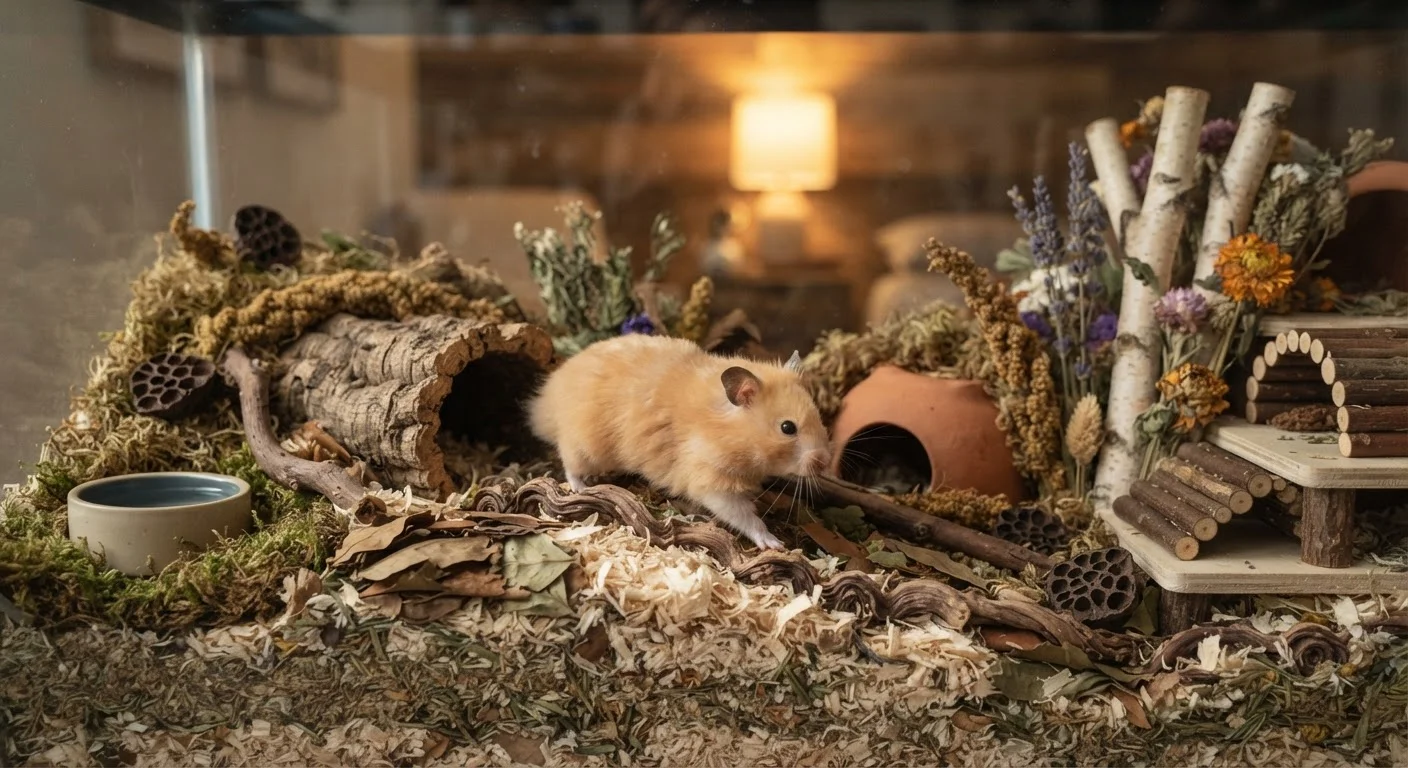
Beyond floor space, substrate depth is a critical and frequently ignored factor. Hamsters are obligate burrowers. Without at least 6 inches of bedding — and ideally 10 or more inches in part of the enclosure — they cannot express natural burrowing behavior, which is linked to security and stress regulation. Wire-bottom or shallow-tray cages make this impossible.
Wheel size is another non-negotiable: a Syrian hamster needs a solid-surface wheel of at least 10–11 inches in diameter to run without spinal curvature. Dwarf species require a minimum of 8 inches. Mesh wheels and small plastic wheels carry injury risk and should be avoided. For comparison, space and enrichment needs across species are similarly misunderstood — as detailed in our overview of rabbit housing and social needs.
Wire Floors and Shallow Trays Cause Real Harm
Wire-bottom cages prevent burrowing entirely and create a risk of bumblefoot — a painful bacterial infection of the foot pads caused by chronic wire pressure. Shallow plastic trays cannot accommodate adequate substrate depth. Neither design supports the basic behavioral and physical needs of hamsters, regardless of other features the cage may offer.
Nutrition also plays a role in overall wellbeing. A hamster in an adequate enclosure still needs a varied, species-appropriate diet — our resource on small mammal nutrition covers species-specific dietary requirements in detail.
This article provides general care information for educational purposes and is not a substitute for guidance from a qualified exotic animal veterinarian.