What Smart Home Devices Are Actually Collecting
Most people know, in a general sense, that smart devices collect some data. Fewer people take time to investigate what that actually means for their household. Before weighing the trade-offs, it helps to be concrete about the categories of information involved.
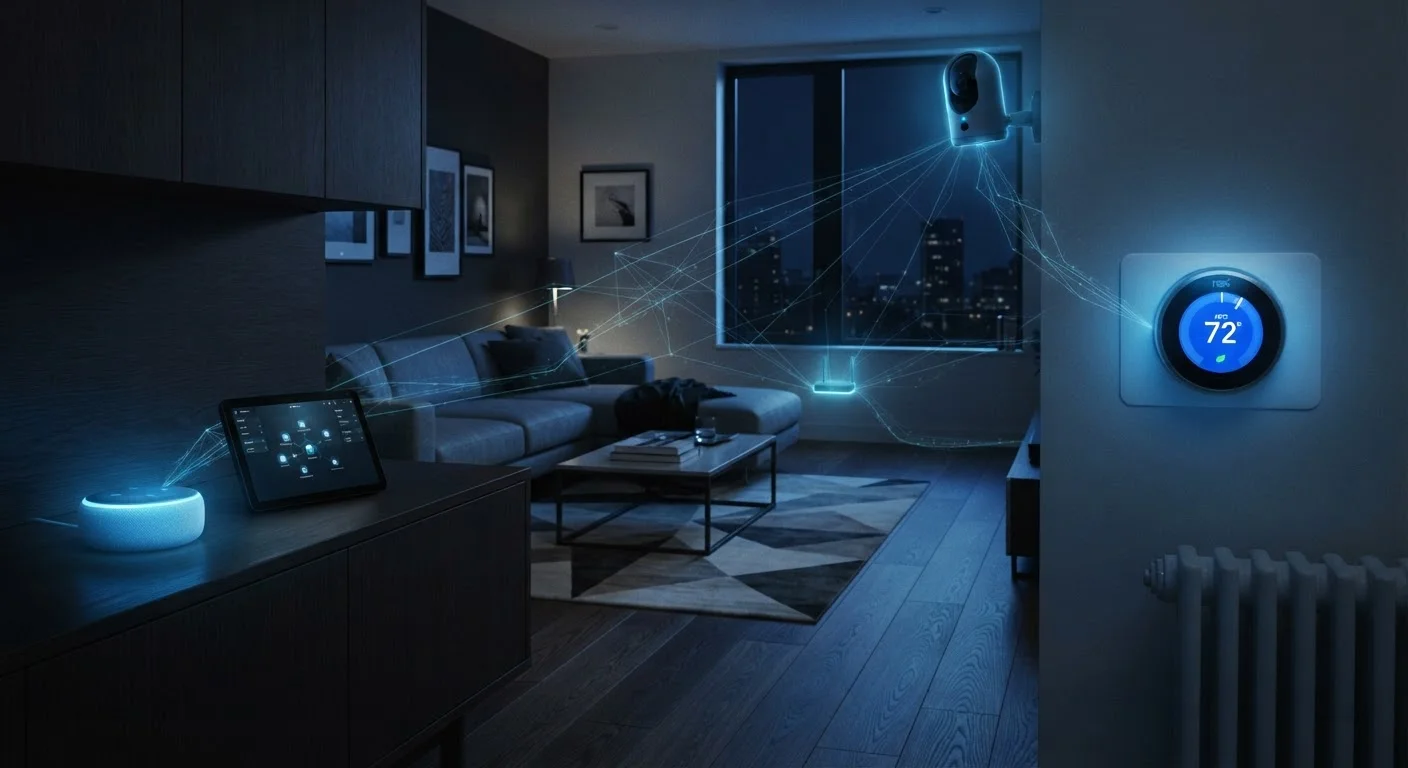
Smart speakers and voice assistants are designed to listen for a wake word — but they can occasionally activate and record snippets without one. Those recordings are typically sent to cloud servers for processing, and some platforms store them unless you actively opt out. Smart cameras and video doorbells store footage, often in the cloud, which may be accessible to the manufacturer and, under certain legal conditions, to law enforcement. Smart thermostats and plugs log usage patterns that can reveal when you're home, asleep, or away. Even app-connected appliances collect behavioral data that feeds back into platform profiles.
For a broader foundation on how these devices work, see what smart home technology really does.
This Is General Information, Not Legal Advice
Data-collection practices, privacy laws, and manufacturer policies vary significantly by device, region, and over time. What applies to one platform may not apply to another. Always read the privacy policy for each specific device you own, and consult the manufacturer's support documentation for current settings options. For questions about your legal rights regarding data, consider consulting a qualified privacy attorney.
The Real Advantages — and Why They Matter
Understanding the data picture doesn't mean the benefits aren't real. For many households, the comfort and utility gains are significant and worth weighing honestly.
Automation reduces daily friction and mental load
Routines that run without manual input — like lights dimming at bedtime or the thermostat adjusting before you wake — remove a steady stream of small decisions from your day.
Remote access provides genuine peace of mind
Being able to check whether a door is locked or see a camera feed while traveling addresses real anxieties, not just convenience preferences.
Usage data can inform more efficient energy habits
Detailed logs of when and how appliances run can help households identify waste and adjust behavior — though this benefit requires sharing that data with the platform.
Accessibility benefits are meaningful for many users
Voice control and automation are not just conveniences for able-bodied users — they can significantly expand independence for people with mobility or cognitive challenges.
Automation genuinely reduces low-level decision fatigue — lights that adjust to time of day, thermostats that learn your schedule, and locks you can check remotely are all things that quietly improve daily life. For people with mobility limitations or demanding schedules, these aren't luxuries. And voice assistants versus dedicated apps each offer different convenience models worth understanding before committing to one approach.
The Real Disadvantages — and What You Can Do About Them
The disadvantages aren't hypothetical. They show up in privacy policies, in news coverage of data breaches, and in the daily behavior of devices most people never fully configure.
Always-on microphones create passive recording risks
Wake-word detection systems can misfire, capturing unintended audio clips that may be stored and reviewed by platform employees or algorithms, depending on privacy settings.
Cloud-stored footage is subject to third-party access
Video from smart doorbells and cameras stored on manufacturer servers can, under applicable law, be requested by law enforcement without your direct knowledge or consent.
Behavioral data builds detailed household profiles
Usage patterns from thermostats, smart plugs, and connected appliances can reveal occupancy schedules, sleep habits, and daily routines — data that has commercial value to advertisers.
Privacy policies are long, complex, and subject to change
Manufacturers can update data-sharing terms after purchase, and most users never read the original policy let alone track subsequent changes.
Device abandonment creates lasting security gaps
When a manufacturer stops issuing firmware updates, vulnerabilities in that device remain on your network indefinitely unless you remove or replace the device.
The practical response isn't to unplug everything — it's to treat device setup as a two-step process: installation, then a deliberate review of privacy settings. Disable features you don't use (like always-on listening modes if you prefer manual activation). Review which data the app is allowed to share with third parties. For camera systems specifically, understand where footage is stored and who can request access. Our guide on keeping smart home devices secure covers the practical habits that reduce common vulnerabilities.
Questions Worth Asking Before You Add a New Device
The most effective privacy habit isn't a technical one — it's a question-asking one. Before adding any new connected device to your home, a short checklist can surface the issues that matter most.
- Where is my data stored? On-device or local storage carries different risks than cloud storage controlled by a third party.
- Can I use this device without creating an account? Some devices require cloud accounts; others work fully offline or on a local network.
- What happens to my data if the company is acquired or shuts down? This is a real scenario, not an edge case.
- Does this device have a physical privacy switch? A hardware mute button on a smart speaker, for example, provides a more reliable off state than a software setting.
- How long does the manufacturer support this device with updates? Unsupported devices become security vulnerabilities over time — a point expanded in our guide on privacy trade-offs of smart home devices.
72%
Smart home owners who review privacy settings
A Pew Research Center survey found roughly 72% of Americans feel that all they do online is being tracked by advertisers and companies, reflecting broad awareness without always translating into action on device settings.
89%
Share of smart speakers requiring cloud processing
Most major smart speaker platforms route voice commands through remote servers rather than processing them entirely on-device, according to general industry architecture disclosures.
Taking time to ask these questions at the point of purchase is far more effective than trying to reconfigure a device that's already embedded in your daily routine.