What Exfoliation Actually Does
Your skin naturally sheds dead cells roughly every 28 to 40 days — a process that slows with age. When those cells linger, they can leave skin looking dull, clog pores, and make it harder for moisturizers to absorb effectively. Exfoliation accelerates that shedding process, and there are two fundamentally different ways to get there.
Before you choose a method, it helps to know your starting point. Check out our guide on understanding your skin type — it's the single most useful step before adding any new exfoliant to your routine.
Chemical Exfoliants: How They Work
Chemical exfoliants use active ingredients — typically acids or enzymes — to loosen the bonds holding dead skin cells together, allowing them to shed without any scrubbing. The main categories are:
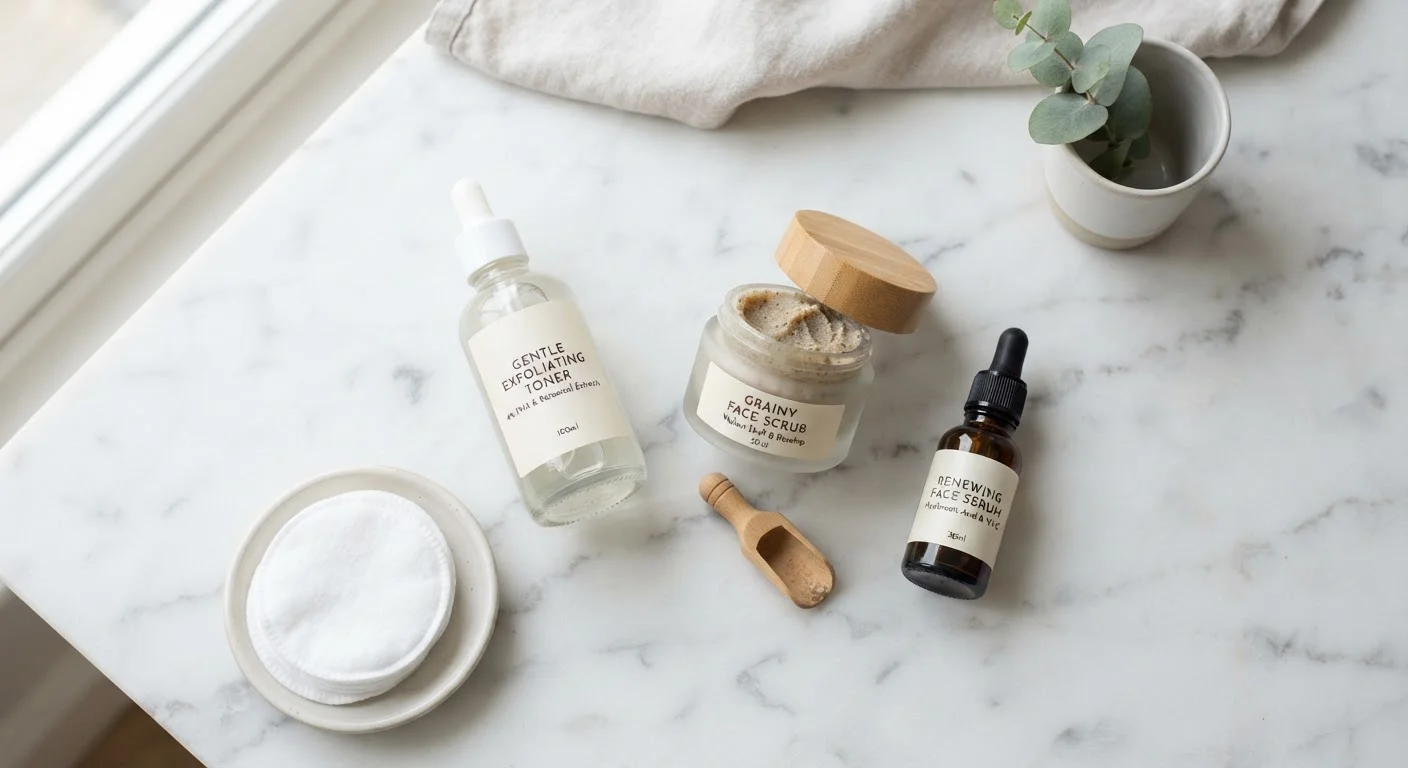
- AHAs (alpha-hydroxy acids) like glycolic and lactic acid work on the skin's surface. They're well-studied for improving texture, brightness, and fine lines. Lactic acid tends to be milder, making it a common starting point.
- BHAs (beta-hydroxy acids), primarily salicylic acid, are oil-soluble, meaning they can penetrate into pores. They're widely used for oily and acne-prone skin.
- PHAs (polyhydroxy acids) have a larger molecular size, so they absorb more slowly and cause less irritation — often recommended for sensitive skin.
- Enzymes (from papaya or pineapple, for example) digest dead cells gently, making them among the mildest options available.
Chemical exfoliants require no rubbing, which makes them less likely to cause the micro-tears associated with harsh physical friction. That said, active acids can increase sun sensitivity, so SPF use during the day is important.
Patch Test Before Committing
Whether you're trying a new AHA toner or a new sugar scrub, always do a patch test on a small area of your inner arm or jaw first. Wait 24 hours to see how your skin responds before applying it to your full face. This small step can save a lot of frustration if an ingredient doesn't agree with your skin.
Physical Scrubs: How They Work
Physical exfoliants manually buff away dead skin using a gritty or textured material — think sugar granules, salt crystals, finely ground oats, or synthetic microbeads (though microbeads are now banned in rinse-off products in the US due to environmental concerns). The scrubbing action is immediate and tangible, which many people find satisfying.
When the particles are uniform and fine — like finely milled sugar or rice bran — physical scrubs can be genuinely gentle. The problem arises with irregular, sharp-edged particles (like crushed walnut shells or coarse sea salt) applied with too much pressure, which can create micro-abrasions on the skin's surface, especially on thinner facial skin.
Avoid Harsh Particles on Facial Skin
Not all physical scrubs are created equal. Formulas containing jagged or irregular particles — like crushed nut shells — can cause micro-tears in the skin surface, which may worsen inflammation rather than reduce it. For the face, look for scrubs with uniformly round, fine particles and use a feather-light touch. When in doubt, a washcloth provides gentle physical exfoliation without added friction risk.
Physical scrubs tend to work best on the body, where skin is thicker and more resilient. On the face, formulation matters enormously — a soft, round-particle scrub used gently is very different from an aggressive grain-heavy formula.
Side-by-Side: What Each Approach Offers
Here's how the two methods stack up across the criteria that matter most for building a sustainable routine:
| Chemical Exfoliants | Physical Scrubs | |
|---|---|---|
| How they work | Dissolve dead cell bonds via acids/enzymes | Manually buff away dead cells via friction |
| Best skin types | Sensitive, acne-prone, oily, aging | Normal to resilient, less reactive skin |
| Risk of irritation | Low to moderate if used correctly | Moderate to high with coarse particles |
| Sun sensitivity | Increased (SPF required during day) | Minimal additional sensitivity |
| Learning curve | Moderate — acids need careful concentration matching | Low — straightforward application |
| Target concerns | Texture, pores, dark spots, dullness | Surface roughness, dullness |
Keep in mind that frequency matters as much as method. Exfoliating more than two or three times per week — especially with potent formulas — can strip the skin barrier and cause redness, flaking, or increased sensitivity. If you're new to exfoliation, once a week is a sensible starting point.
Fitting Exfoliation Into Your Routine
Exfoliation doesn't exist in isolation — it interacts with everything else in your routine. Applied after cleansing and before serums or moisturizers, chemical exfoliants work best on clean, dry skin (unless a formula specifies otherwise). Physical scrubs are typically used in place of your regular cleanser or immediately after.
Because exfoliation preps the skin's surface, it can actually improve how well your other products absorb. Our guide on skincare product layering order explains where each step belongs so nothing cancels anything else out.
If you exfoliate in the evening — which is often recommended for chemical exfoliants, especially AHAs — your nighttime routine becomes especially important. The skin's repair cycle is most active at night, and supporting it with the right steps can make a real difference. See our overview of evening skincare essentials for guidance on building that routine thoughtfully.
This article is for general informational purposes only. If you have a skin condition or are under dermatological care, consult a qualified healthcare professional before introducing new exfoliating products into your routine.