Why Budgeting Matters More Than People Think
Most people associate budgeting with restriction — a list of things they can no longer do. In reality, a budget is simply a spending plan: a deliberate decision about where your money goes before it arrives, rather than a scramble to figure out where it went after the fact.
Without a plan, spending tends to drift toward convenience rather than priority. Subscriptions accumulate. Discretionary purchases fill the gaps. By the end of the month, the number in your account can feel surprising in a way that a budget would have prevented.
The goal is awareness, not perfection. Even a rough plan gives you the information to make trade-offs consciously. To understand why cash flow is the foundation beneath any budget, see where your money actually goes before diving deeper into formats and systems.
Core Concepts Every Beginner Should Know
Budget
A plan that assigns your income to specific spending categories before the month begins, so money is directed rather than simply spent.
Net income
The amount of money you actually take home after taxes and other deductions are removed from your gross pay.
Fixed expense
A recurring cost that stays the same each month, such as rent or a car loan payment.
Variable expense
A cost that changes month to month depending on your choices or circumstances, like groceries, dining out, or utilities.
Discretionary spending
Money spent on non-essential wants — entertainment, hobbies, subscriptions — rather than necessities.
Cash flow
The movement of money into and out of your finances over a period of time; positive cash flow means you earn more than you spend.
Before choosing any budgeting method, you need a clear picture of two numbers: what comes in each month and what goes out. Income is straightforward for salaried workers but requires averaging for anyone with variable pay — freelancers, hourly workers, or those with side income should use a conservative estimate based on recent months.
Expenses split into two broad categories: fixed (rent, loan payments, insurance premiums — amounts that stay the same) and variable (groceries, utilities, entertainment — amounts that shift). Variable expenses are where most beginners underestimate their spending, which is why tracking even one month of actual transactions is more useful than guessing.
Common Budgeting Formats Explained
No single budgeting format works for everyone. Here are the most widely used approaches and what each demands:
- 50/30/20 rule: Allocates roughly 50% of after-tax income to needs, 30% to wants, and 20% to savings or debt repayment. Low-effort and flexible — a good entry point for most beginners.
- Zero-based budgeting: Every dollar of income is assigned a job so that income minus expenses equals zero. More precise but more time-intensive. Learn what zero-based budgeting actually means to decide if it fits your situation.
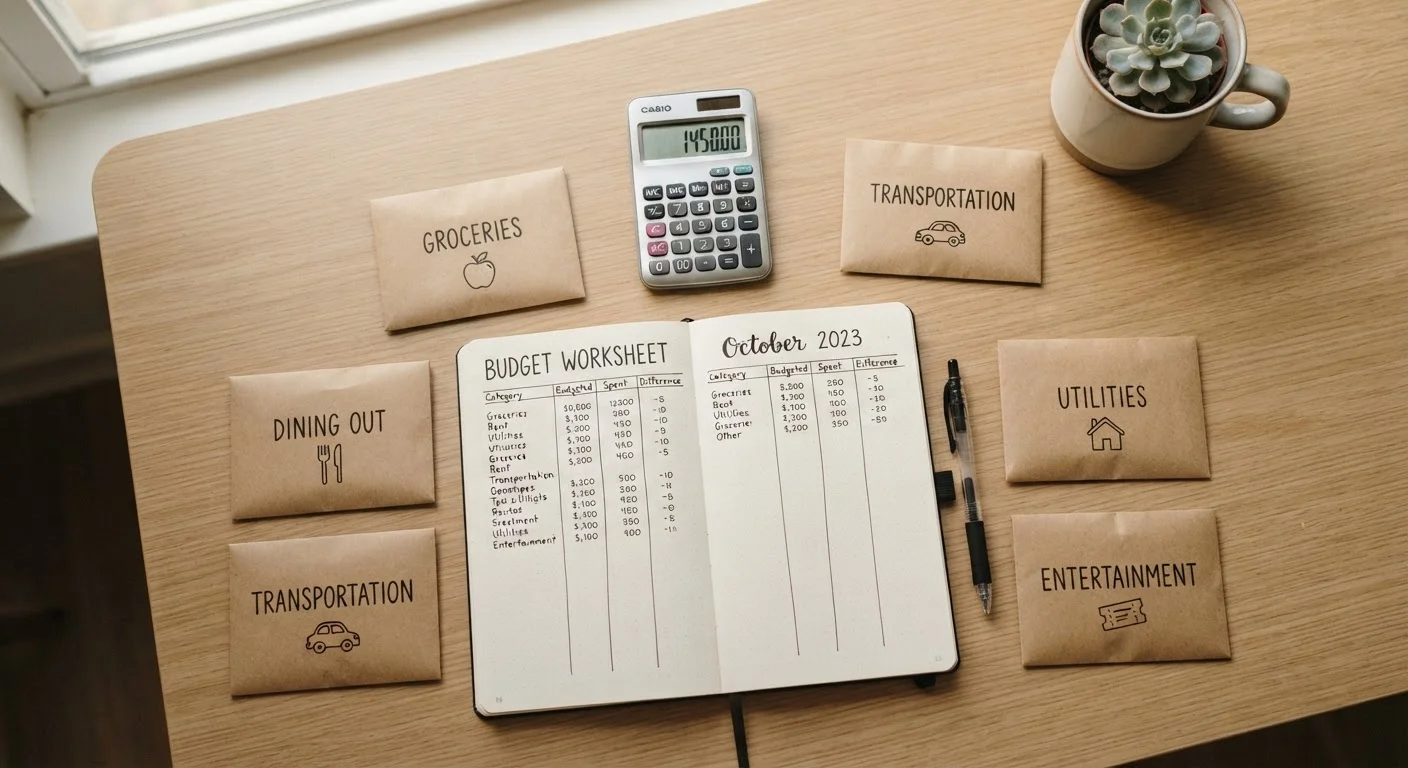
- Envelope method: Cash is divided into physical or digital envelopes by category. Spending stops when an envelope is empty. Useful for people who overspend in specific categories and want a hard boundary.
- Pay-yourself-first: Savings or debt payments are moved automatically at the start of the month; the remainder is spent freely. Simplifies decision-making by treating saving as a non-negotiable fixed expense.
Start Simple, Adjust Later
If you have never budgeted before, resist the urge to categorize every possible expense on day one. Begin with five broad categories: housing, transportation, food, savings, and everything else. Once you have a month or two of data, you can split categories with more precision. A rough budget you stick to beats a detailed one you abandon.
Each format has trade-offs. The best one is the format you will actually maintain. Starting with something simple and adjusting later beats choosing a sophisticated system and abandoning it after two weeks.
Where Most Beginners Should Start
The most common mistake beginners make is trying to build a complete budget before they understand their actual spending. A better first step: spend 30 minutes reviewing the past two months of bank and credit card statements, categorizing each transaction roughly. That single exercise often reveals more than any budgeting app onboarding screen.
From there, write down your monthly take-home income and subtract your fixed expenses. What remains is your discretionary pool. Decide, in advance, how much of that pool goes to variable necessities (groceries, gas), how much to savings, and how much is genuinely flexible spending.
For a structured walkthrough of this process, building your first budget from scratch covers each step in plain language. Alternatively, getting started without prior tracking experience is designed for those who have no baseline data at all.
Variable Income Requires Extra Care
If your monthly income fluctuates — due to freelance work, tips, commissions, or seasonal employment — base your budget on your lowest recent earning month rather than your average. This conservative approach prevents you from committing to expenses you may not always be able to cover. In higher-earning months, direct the surplus to savings or debt reduction rather than lifestyle expansion.
Small Moves That Add Up Over Time
Budgeting's long-term value comes less from dramatic one-time decisions and more from small, consistent habits. A few practical examples:
- Reviewing your bank balance every Sunday takes under five minutes and prevents end-of-month surprises.
- Setting one automatic transfer — even a modest amount — to a separate savings account on payday removes the temptation to spend first and save what is left.
- Auditing recurring subscriptions quarterly can surface forgotten charges that are easy to cancel.
- Rounding up discretionary estimates when planning (budgeting $200 for groceries when you typically spend $180) builds a small buffer that reduces stress when variable costs run slightly high.
None of these moves require sacrifice. They require attention. Over months and years, the gap between what you earn and what you spend mindlessly narrows — and that gap is where financial stability is built. Explore the budgeting basics hub for more structured guidance as you develop your approach, and saving and debt strategies when you are ready to put a surplus to work.
This article is for general informational and educational purposes only and does not constitute personalised financial, tax, or legal advice. For guidance specific to your situation, consult a qualified financial professional.