How Each System Actually Works
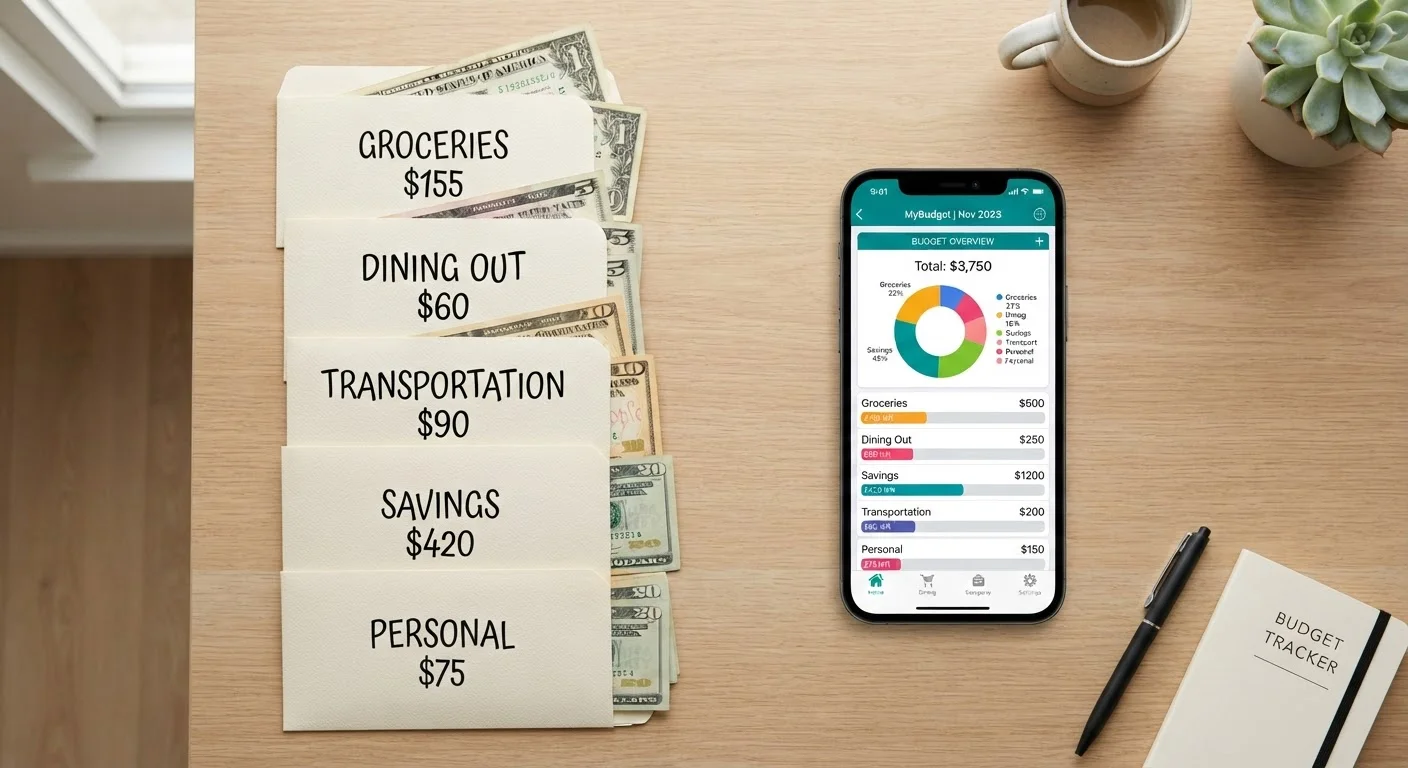
The cash envelope method is straightforward: at the start of each pay period, you withdraw physical cash and divide it into labeled envelopes — groceries, gas, dining out, entertainment, and so on. Once an envelope is empty, spending in that category stops until the next funding cycle. There is no app, no bank alert, and no digital override. The constraint is literal.
Digital budgeting apps work differently. After linking your bank accounts and cards, the app imports transactions automatically and maps them to spending categories you define. You set limits per category, and the app tracks your pace in real time, sending alerts when you approach or exceed a threshold. The spending still happens in the digital world — the app is a mirror, not a wall.
Understanding how money moves through your life is foundational to choosing between them. Understanding your personal cash flow helps clarify which categories actually need hard limits versus which just need monitoring.
| Criterion | Cash Envelopes | Digital Budgeting Apps |
|---|---|---|
| Spending control mechanism | Physical cash limit — hard stop | Alerts and category tracking — soft stop |
| Coverage of digital transactions | None — cash only | Full — syncs cards, accounts, subscriptions |
| Setup time | 30–60 minutes per pay period | One-time setup; minimal ongoing effort |
| Spending pattern data | None — manual tracking required | Automatic categorization and history |
| Behavioral friction | High — intentional by design | Low — easy to ignore alerts |
| Best for impulse control | Strong — empty envelope = no spend | Weaker — spending still possible after alert |
| Convenience for modern life | Low — requires cash withdrawals | High — works with existing payment habits |
| Cost | Possible ATM fees; no software cost | Free to paid tiers depending on app |
Where Each Method Genuinely Excels
Cash envelopes deliver something no app can fully replicate: a behavioral speed bump. Research in consumer psychology consistently shows that paying with physical cash reduces the psychological distance between spending and consequence. Handing over a $20 bill registers differently than tapping a card. For categories prone to creep — dining out, impulse shopping, personal care — that friction is a genuine asset.
Digital apps, on the other hand, excel at visibility and coverage. A cash system cannot track your Netflix subscription, your electric bill auto-pay, or any online purchase. Apps capture all of it. They also produce historical data: after three months of use, you can see exactly which categories absorb the most money, identify seasonal patterns, and spot subscriptions you forgot you had. Spending tracker methods that reveal patterns explores how these data-driven approaches compare to analog alternatives in more depth.
~80%
U.S. transactions now cashless
The Federal Reserve's Diary of Consumer Payment Choice has consistently found that the majority of U.S. payments are now made by card or digital method, not cash.
33%
Average budget overage in discretionary categories
Behavioral finance research broadly suggests consumers regularly underestimate discretionary spending by a significant margin when relying on mental accounting alone.
1 in 3
Adults with no working budget
National Foundation for Credit Counseling surveys have repeatedly found that a substantial share of American adults do not follow any formal budget.
The Real Drawbacks Worth Knowing
Cash envelopes have friction that is both their strength and their weakness. Carrying cash is inconvenient in a world optimized for contactless payment. ATM fees add a small but real cost. Cash cannot earn interest while it sits in an envelope. And in an emergency — a car repair, a medical co-pay — the rigid category structure requires deliberate reallocation decisions at a stressful moment.
Digital apps have a different failure mode: passive use. An app that logs every transaction but is never reviewed is functionally useless. Many people set up a budgeting app, feel a brief sense of control, and then stop checking it. Alerts are easy to dismiss. Category overruns are recorded but not corrected. If your budget needs a structural fix rather than just better tracking, the app alone will not solve it — signals that your budget needs a serious overhaul can help you recognize when that's the case.
For a deeper examination of envelope budgeting's trade-offs specifically, the honest pros and cons of envelope budgeting lays out both sides without sugarcoating.
A Note on App Privacy and Data Sharing
Most digital budgeting apps require you to link financial accounts, which means sharing read access to your banking data with a third-party provider. Review each app's privacy policy and data-sharing practices before connecting accounts. Look for apps that use read-only access and clearly state they do not sell your transaction data. When in doubt, consult the app's security disclosures or speak with your bank about its open-banking policies.
Choosing the Right Fit — or Combining Both
The most effective budgeting system is the one you will sustain. That sounds obvious, but it rules out systems that conflict with how you already live. If you make most purchases online or via card, forcing yourself to use cash for everything introduces enough friction to cause abandonment within weeks.
A hybrid approach works well for many households: use cash envelopes for two or three high-risk discretionary categories (groceries, dining, entertainment), and use a digital app to track everything else — fixed expenses, subscriptions, and card spending. You get the behavioral guardrails of cash where they matter most, plus the comprehensive visibility of an app for the rest of your budget.
Whichever system you choose, the underlying principle is the same: small, consistent adjustments — catching a $40 overspend in week two instead of discovering a $200 deficit at month end — are what add up to real savings over time. Mapping your cash flow before selecting a system ensures you're solving the right problem. And if you're weighing broader savings philosophies, paying yourself first vs. budgeting what's left offers a useful companion comparison.
This article is for general informational and educational purposes only and does not constitute personalised financial advice. Consult a qualified financial professional for guidance specific to your situation.