Why Foundation Finish Matters More Than You Might Think
When choosing a foundation, most people focus on shade — and rightly so. But finish is the second decision that shapes everything else about how your skin looks across the day. The wrong finish can make dry skin look powdery or oily skin look greasy by noon, regardless of how perfectly you matched your undertone.
Finish describes the way a formula interacts with light. Because skin reflects and absorbs light differently depending on texture, oil production, and hydration level, the same finish can look completely different on two people with different skin types. Before you can make a confident choice, it helps to understand what each finish actually does — and why. If you haven't pinned down your skin type yet, our guide on understanding skin types is the right starting point.
3 main
Foundation finish categories recognized across the beauty industry
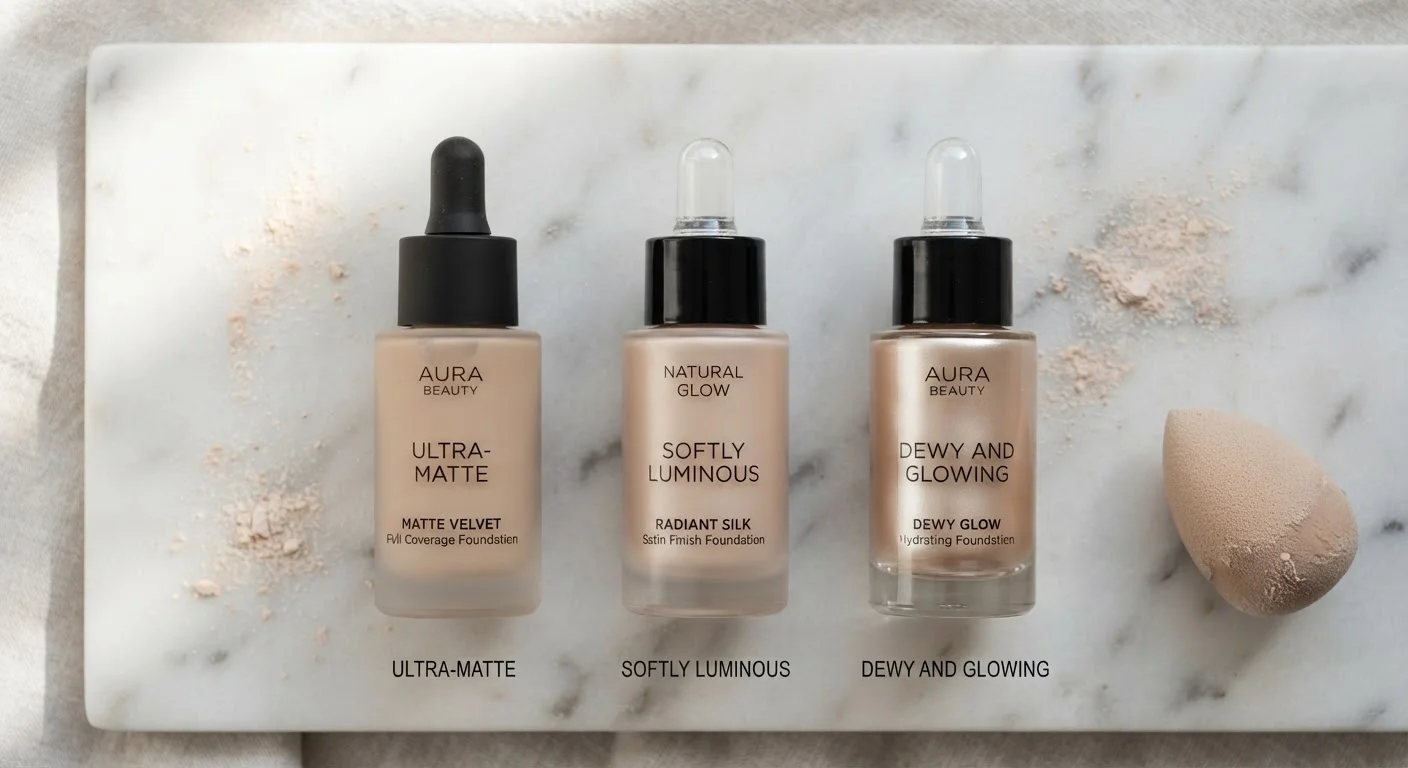
Matte, satin, and dewy are the standard finish descriptors used on product packaging and by makeup artists to communicate the expected light-reflection outcome of a formula.
~65%
People estimated to have combination or oily skin concerns
Dermatology sources broadly estimate that a majority of adults experience some degree of excess oil production, making shine-management a central factor in foundation selection for many shoppers.
Matte: Shine-Control and Full Opacity
A matte foundation dries to a finish with little to no light reflection. The result is even-toned, smooth, and entirely shine-free. Formulas achieve this through oil-absorbing ingredients like silica, kaolin clay, or talc, which soak up sebum as it reaches the surface.
This finish is generally the most practical for oily or acne-prone skin. It controls visible shine throughout the day without the need for frequent blotting or touch-ups. It also photographs cleanly, which is why matte formulas dominate professional makeup kits.
The trade-off: on dry or mature skin, matte foundations can settle into fine lines and emphasize texture rather than smooth it. Skin that is already low on surface oils can look flat or powdery under a formula designed to remove even more shine. If your skin leans dry, a matte finish generally works against you rather than for you.
Dry Skin? Skip the Setting Powder
If your skin runs dry, use a setting spray instead of a loose powder to lock in your foundation. Powder absorbs surface moisture and can exaggerate dry patches over a matte or even satin formula. A fine-mist setting spray locks coverage in place without disrupting the finish or emphasizing texture.
Satin: The Middle Ground Most Skin Types Can Work With
Satin — sometimes labeled natural or soft-matte — lands comfortably between matte and dewy. It leaves a subtle glow that reads as healthy skin rather than shine. There is no dramatic shimmer, and no flat, one-dimensional coverage either.
Because satin formulas don't aggressively absorb oil or flood skin with luminizing particles, they tend to be the most forgiving across different skin types and conditions. Combination skin in particular benefits from a satin finish: it tones down shine in oilier zones while still giving drier areas enough luminosity to look comfortable.
Satin is also less weather-dependent. In humid climates, a matte formula holds; a dewy formula can break down quickly. Satin sits in a range that performs reliably in moderate conditions without requiring as much touch-up strategy.
Dewy: Luminosity and the Hydrated-Skin Effect
A dewy finish reflects light visibly, creating a glossy, glass-skin effect that reads as deeply hydrated. Formulas achieve this with humectants like glycerin, emollient oils, and sometimes luminizing pigments that scatter light outward from the skin's surface.
This finish is most flattering on dry, dull, or mature skin. It counteracts the flat appearance that dryness creates, giving skin a plump, fresh look that other finishes can't replicate. For those whose skin already produces little natural oil, a dewy formula essentially replaces what's missing.
On oily skin, the extra luminosity can amplify shine to a level that reads as sweaty rather than glowing. If the dewy aesthetic appeals to you but your skin leans oily, focusing your routine on skin prep — including well-hydrating serums — can deliver that lit-from-within look without a formula that will slide off by midday. Our breakdown of serums, essences, and ampoules can help you layer effectively beneath any foundation finish.
How Primers and Setting Products Shift the Equation
Foundation finish is not fixed the moment you choose a formula. What goes under and over it can meaningfully change the final result.
A silicone-based, pore-filling primer under a dewy foundation will mute some of its luminosity, pulling it closer to satin. A hydrating, balm-like primer under a matte formula softens its opacity and prevents the flat, cakey effect dry skin is prone to. In both directions, primers act as a modifier for the finish you're working with.
Setting products have an equally strong influence. A loose or pressed powder pushes any finish toward matte — a useful tool for controlling shine in the T-zone while leaving cheeks untouched. A setting spray, particularly a hydrating one, can restore dewiness that powder has muted and re-melt powder particles into the skin for a more seamless effect. Understanding this layering logic means you're not locked into a single finish because of what's on the bottle. Good skincare prep also plays a role here — a strong evening routine supports skin texture that makes every finish perform better, as explored in our evening skincare guide.
Finish Labels Aren't Standardized
Terms like 'natural,' 'radiant,' 'soft-matte,' and 'luminous' are used differently across brands — one brand's 'natural finish' may look closer to another's 'satin.' Swatching in natural light or checking independent beauty reviews gives a more reliable read on actual finish than the descriptor on the packaging alone.