
Why More Income Doesn't Automatically Mean More Savings
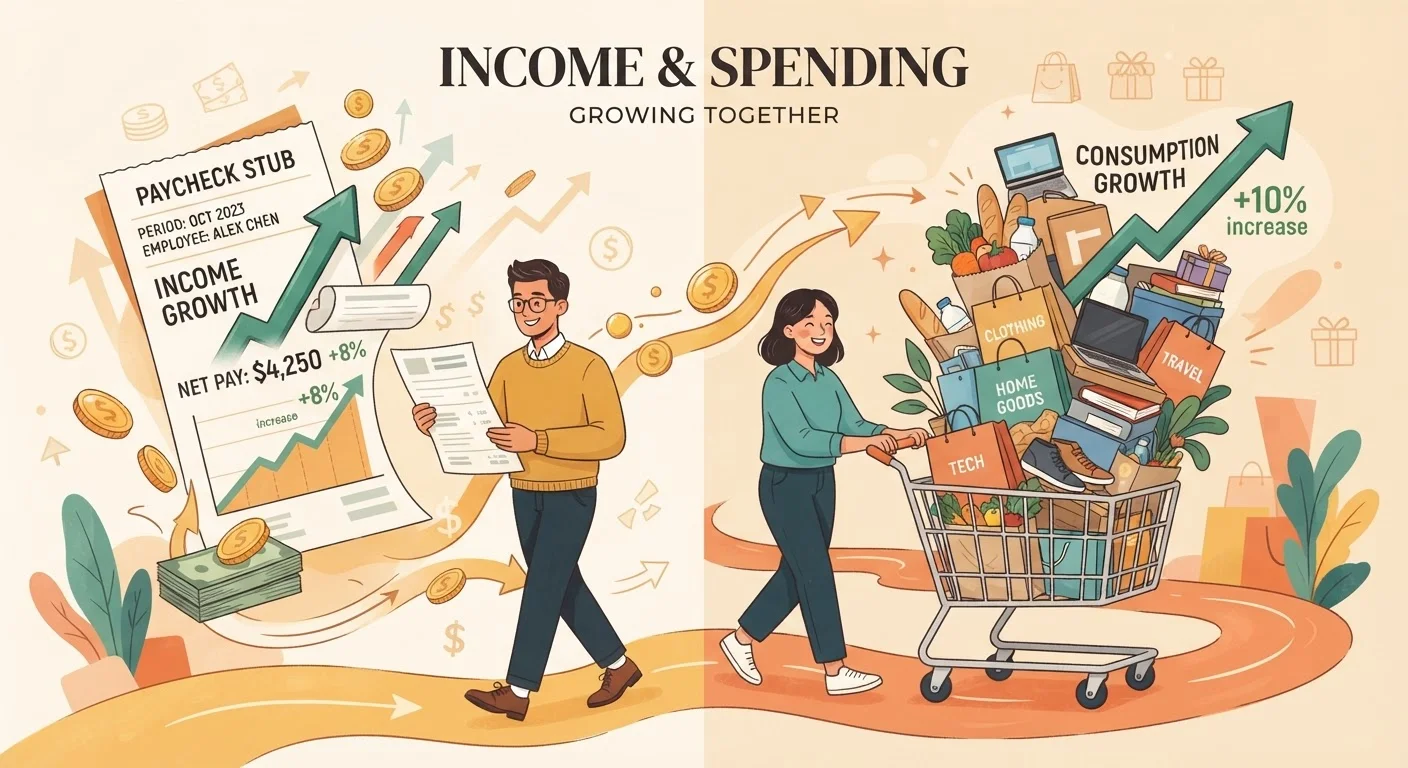
Most people assume that earning more will translate directly into saving more. In practice, this often doesn't happen — and the reason is lifestyle creep. When income rises, spending tends to follow, sometimes matching or exceeding the income gain itself.
The mechanism is subtle. A raise arrives and the monthly cash flow improves. That improvement feels like breathing room. A gym membership gets added. Grocery shopping shifts to a pricier store. A streaming subscription becomes three. None of these feels like a major financial decision. But collectively, they can eliminate the entire benefit of a raise within months.
This dynamic is explored in depth in research on consumer behavior, where the term 'hedonic treadmill' describes how people return to a baseline satisfaction level after each upgrade, prompting the next one. The financial result is that savings rates remain flat even as gross income climbs steadily over years.
~33%
Americans with no emergency savings
Federal Reserve surveys have consistently found that a significant share of U.S. adults could not cover an unexpected $400 expense without borrowing — a figure that persists across income levels, reflecting how spending tends to scale with earnings.
Flat
Median U.S. personal savings rate over time
Despite decades of rising median household incomes, the U.S. personal savings rate has shown long-term declining trends, suggesting that income growth alone does not drive savings growth for most households.
The Mechanics of Gradual Spending Drift
Lifestyle creep works through several overlapping patterns. The first is the normalization of discretionary spending. When dining out becomes a three-times-a-week habit instead of a treat, it stops feeling optional. The second pattern is social calibration — spending adjusts to match peers, colleagues, or a new neighborhood. The third is the 'I've earned this' reasoning, where income growth is mentally converted into permission to spend rather than an opportunity to save.
It's also worth recognizing that many of these spending shifts are tied to small daily expenses that feel insignificant in isolation. A slightly better coffee each morning, a premium app here, a convenience delivery fee there — these don't trigger the same scrutiny as large purchases, but they accumulate in ways that matter at the end of the year.
Practical Ways to Keep Lifestyle Creep in Check
The most effective counterweight to lifestyle creep is removing the decision entirely at the point where income arrives. Automating a fixed percentage of each paycheck directly into savings or a retirement account means the money is allocated before discretionary choices are made. This approach doesn't require ongoing willpower — the structure does the work.
A second practical step is to conduct an honest audit whenever income increases. Before spending any raise or bonus differently, list current recurring expenses and flag which ones were added in the past 12 to 24 months. This makes the creep visible rather than invisible.
Try the 'Half the Raise' Rule
When your income increases, consider directing at least half of the net gain directly to savings or debt repayment before adjusting any spending habits. This approach lets you enjoy some of the benefit of earning more while still making meaningful progress on financial goals. It sidesteps the all-or-nothing trap of either spending everything or saving everything.
Finally, applying a simple filter — 'Does this upgrade reflect what I actually value, or is it just a default upgrade?' — can separate spending that genuinely adds quality of life from spending that simply raises the baseline. The goal isn't frugality for its own sake; it's intentionality. Selective upgrading is sustainable. Automatic upgrading is what erodes savings over time.
This article is for general informational and educational purposes only and does not constitute personalized financial advice. For guidance specific to your financial situation, consult a licensed financial professional.