
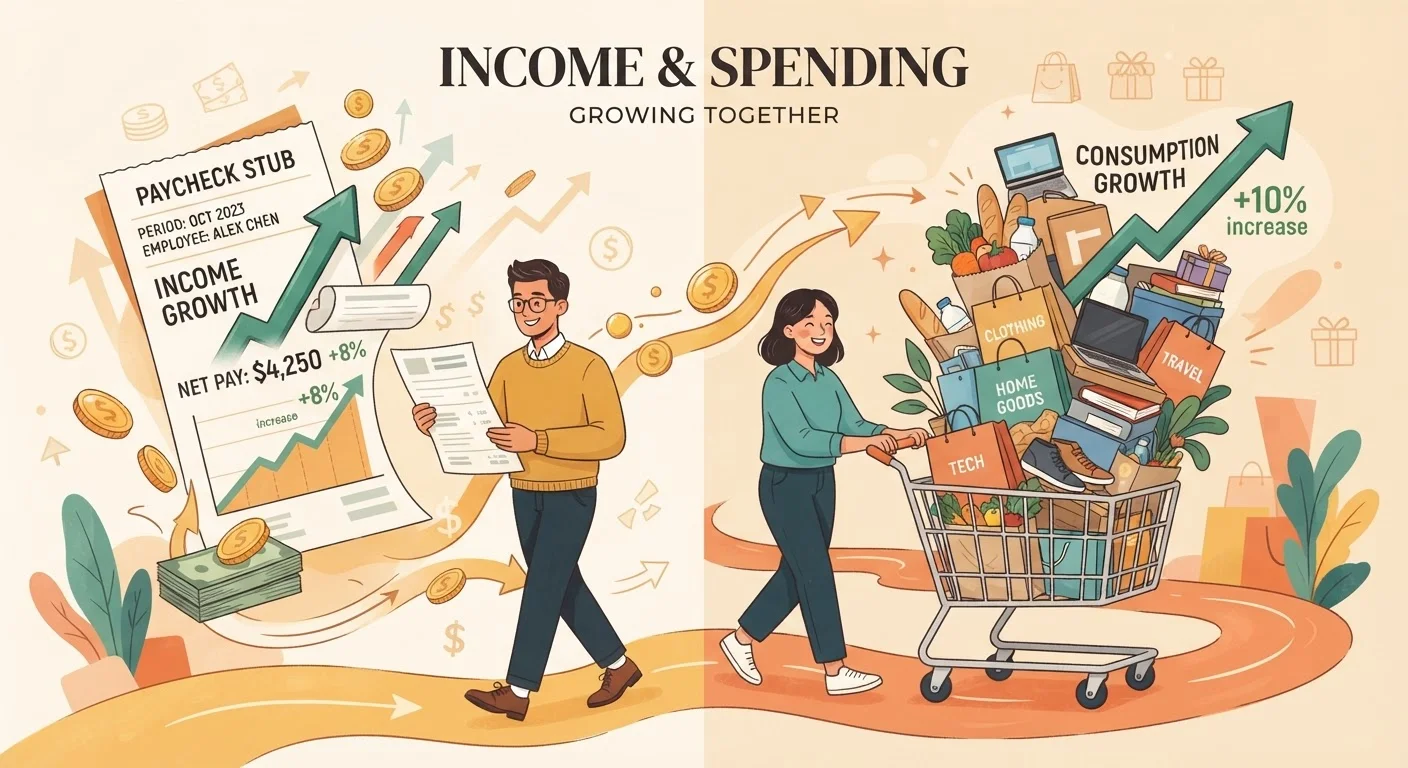
Why Raises Disappear Without a Trace
You land a promotion. Your paycheck is meaningfully larger. For a few weeks, things feel different — then, somehow, they don't. The money feels just as tight as before. This experience is common, and it has a name: lifestyle inflation.
The mechanics are straightforward. When income increases, our reference point for 'normal' spending shifts upward. A slightly nicer apartment seems reasonable now. Ordering delivery a few more nights a week doesn't feel extravagant. Upgrading your gym membership, adding a streaming service, buying clothes at a higher price point — each move seems proportionate to your new income. Individually, none of these decisions is alarming. Together, they absorb the raise entirely.
This is why many Americans report that, regardless of how much they earn, money always feels tight. Understanding how budgets actually work is harder when the spending baseline keeps moving.
70%
Americans living paycheck to paycheck
Surveys consistently show a majority of U.S. adults report spending most or all of their monthly income, regardless of income level.
~$219/month
Average U.S. household subscription spend
Research from subscription management platforms has found American households regularly underestimate their recurring subscription costs by a wide margin.
3x
Income growth vs. savings growth gap
Federal Reserve data has shown that median household income growth often substantially outpaces growth in household savings balances over comparable time periods.
The Mechanics: How Small Upgrades Stack Up
Lifestyle inflation rarely arrives as one large decision. It accumulates in small, recurring changes that are easy to rationalize individually but significant in aggregate.
Consider a household that receives a $500-per-month raise after taxes. Over the following year, they move to an apartment that costs $150 more per month, add two streaming subscriptions at $30 combined, start buying lunch at work three days a week instead of packing it ($120/month), and upgrade their phone plan ($40/month). That's $340 per month in new recurring spending — more than two-thirds of the raise absorbed, with no single decision feeling like an overreach.
The pattern is not irrational. Humans adapt to circumstances, and what felt like a splurge at a lower income feels like a baseline at a higher one. Behavioral economists call this hedonic adaptation — we adjust to new conditions quickly and return to a similar level of satisfaction, having locked in a more expensive lifestyle in the process.
Try the 'Save First' Rule on Any Raise
Before adjusting a single spending habit after a pay increase, redirect a portion of the new income to savings or debt repayment — ideally through automatic transfer. Even committing 50% of each raise to savings while spending the rest more freely can meaningfully shift long-term outcomes. Once the transfer is automated, the remaining increase can be spent without guilt or complex tracking.
Why This Matters for Long-Term Financial Health
The compounding cost of lifestyle inflation is what makes it financially significant over time. If every raise is fully absorbed by spending, your savings rate stays flat even as your income climbs. A person earning $60,000 who saves 8% of income and then earns $80,000 but still saves only 8% has gained little ground relative to their potential — and has locked in a lifestyle that requires $80,000 to sustain.
This has real consequences for retirement readiness, emergency reserves, and debt repayment. Building savings and reducing debt becomes structurally harder when every income increase is pre-committed to a higher cost of living before it's ever directed elsewhere.
There's also a risk asymmetry worth noting: lifestyle upgrades are easy to adopt and psychologically difficult to reverse. Moving to a cheaper apartment, downgrading a phone plan, or cutting subscriptions all feel like losses — even if they simply return you to where you were financially not long ago.
Practical Approaches to Keep Inflation in Check
The goal isn't to freeze your lifestyle permanently at the level of your first job. Spending more as you earn more is reasonable and can genuinely improve quality of life. The discipline is in making those spending decisions deliberately rather than by default.
A widely cited framework is to split income increases: direct a defined share — say, half — toward savings or debt reduction before adjusting any discretionary spending. If a raise adds $400 per month after tax, committing $200 of it to savings immediately separates income growth from lifestyle growth in a concrete way. Automating that transfer removes the temptation to spend first and save what's left.
It also helps to periodically audit recurring costs. Subscriptions, memberships, and service upgrades accumulate quietly. A quarterly review of what you're paying monthly — and whether each item is actively used and valued — can surface spending that has outlasted its usefulness.
For those whose income isn't predictable, the same logic applies but requires a different structure. Budgeting with a variable paycheck demands building savings commitments into the structure of how income is allocated, not just the amount.
Finally, it's worth interrogating whether specific upgrades are driven by genuine preference or by social comparison. Spending that reflects your actual priorities tends to deliver lasting satisfaction. Spending driven by keeping pace with peers or signaling status rarely does — and is a particularly reliable engine of lifestyle inflation.
This article is for general informational and educational purposes only and does not constitute personalized financial advice. Consult a qualified financial professional regarding your individual circumstances.