
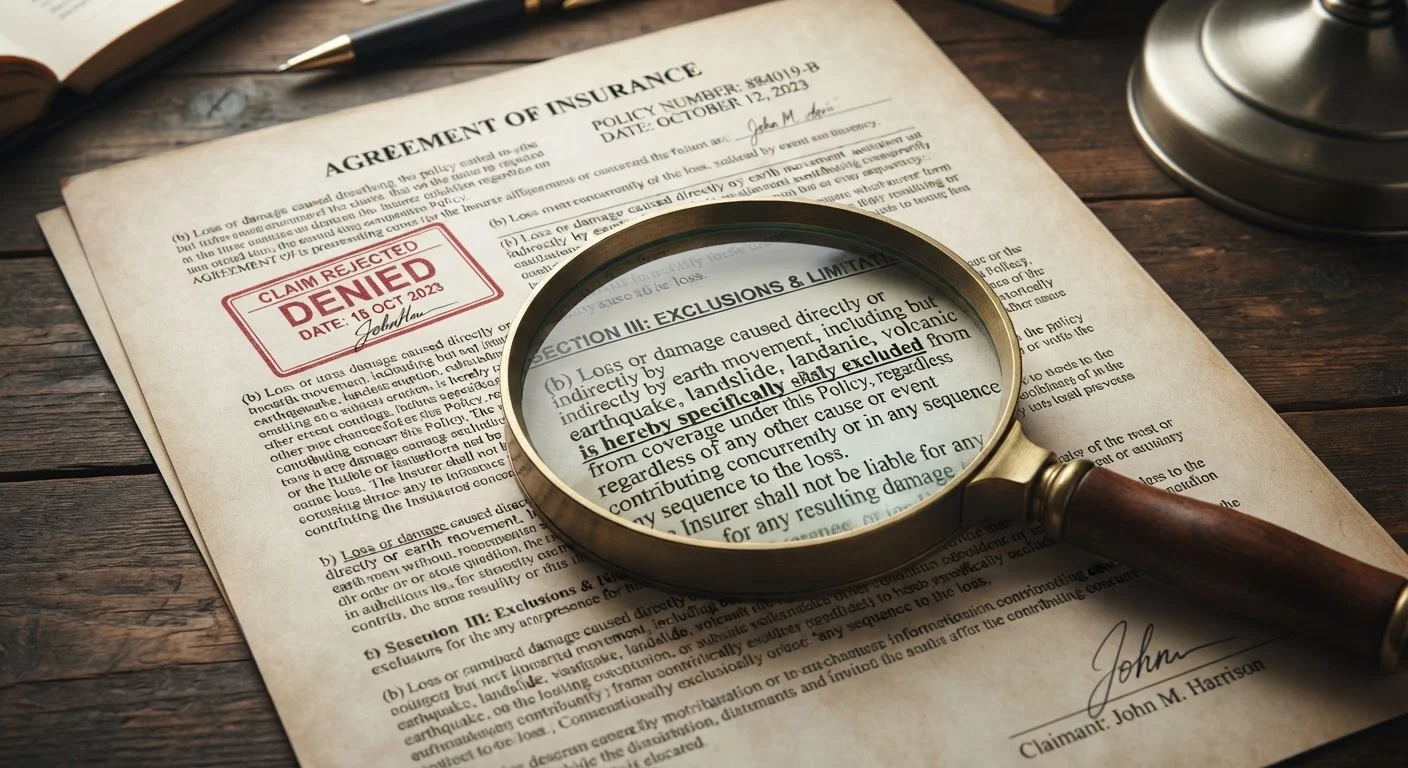
Denials Aren't Random — They're Written Into Your Policy
When an insurer denies a claim, it almost always points to a specific section of your policy as justification. The denial letter may quote clause numbers, use terms like "excluded peril" or "policy conditions," and reference language that you may never have read. That's not a coincidence — it's how the system is designed to work.
Understanding which provisions trigger denials — and why — puts you in a much stronger position, whether you're reviewing coverage before buying or disputing a denial after the fact. As a starting point, our field guide to core policy terms can help you decode the language you'll encounter most often.
This article maps the most common denial reasons to the exact policy structures behind them.
Filing a claim for an explicitly excluded peril.
Why it happens: Policyholders often assume broad coverage without reading the exclusions section, which can run several pages in a standard policy.
Missing the required reporting window after a loss.
Why it happens: Policies include "prompt notice" or "timely reporting" conditions, but few policyholders know the exact timeframe — or that missing it can void an otherwise valid claim.
Making a material misrepresentation on the application.
Why it happens: Some applicants omit or understate information they consider minor — prior claims history, property use, or health conditions — not realizing insurers treat accuracy as a condition of coverage.
Filing a claim outside the policy period or trigger date.
Why it happens: Confusion between "occurrence" and "claims-made" policy forms leads policyholders to file at the wrong time, or assume coverage applies to incidents that predate the policy.
Failing to document or preserve evidence of the loss.
Why it happens: Many policyholders immediately begin cleanup or repairs after a loss without understanding that most policies require the insured to protect property from further damage and allow inspection before repairs begin.
The Policy Provisions Most Likely to Trigger a Denial
Beyond the individual mistakes above, a few structural policy elements deserve special attention because they generate denials across nearly every insurance type.
A Denial Letter Is Not the Final Word
Every insurer is required to provide a written explanation citing the specific policy language behind a denial. You have the right to formally appeal, and in many states you can also request an independent review through your state's department of insurance. Keep copies of all correspondence, and if the dollar amount is significant, consider consulting a licensed public adjuster or attorney who specializes in insurance disputes.
Conditions vs. Exclusions
These two sections serve different functions. Exclusions define what the policy will never cover — specific perils, property types, or situations explicitly carved out. Conditions define what you must do to keep coverage in force — like reporting a claim promptly, cooperating with an investigation, or paying premiums on time. Violating a condition can void an otherwise valid claim even when the loss itself would have been covered. For a deeper look at what typically falls outside coverage entirely, see what insurance policies don't cover.
The Declarations Page as a Coverage Map
Your declarations page ("dec page") summarizes your coverage limits, named insureds, effective dates, and any endorsements. If a claim involves a property, person, or date not reflected on the dec page, the insurer has a straightforward basis for denial. Checking this page annually — not just at purchase — is one of the most practical habits a policyholder can build.
It's also worth knowing that coverage terms aren't uniform. Underwriting decisions shape which exclusions appear in your specific policy, which means two policies from the same insurer can cover very different things.
This article is for general informational purposes only and does not constitute insurance, legal, or financial advice. Coverage, exclusions, and claim processes vary by insurer and jurisdiction. Always read your actual policy documents and consult a licensed insurance professional for guidance specific to your situation.