
Why These Four Types Matter
Insurance is, at its core, a way of turning unpredictable large losses into predictable small costs. Rather than absorbing a $200,000 hospital bill or rebuilding a home out of pocket, you pay regular premiums and transfer that financial risk to an insurer.
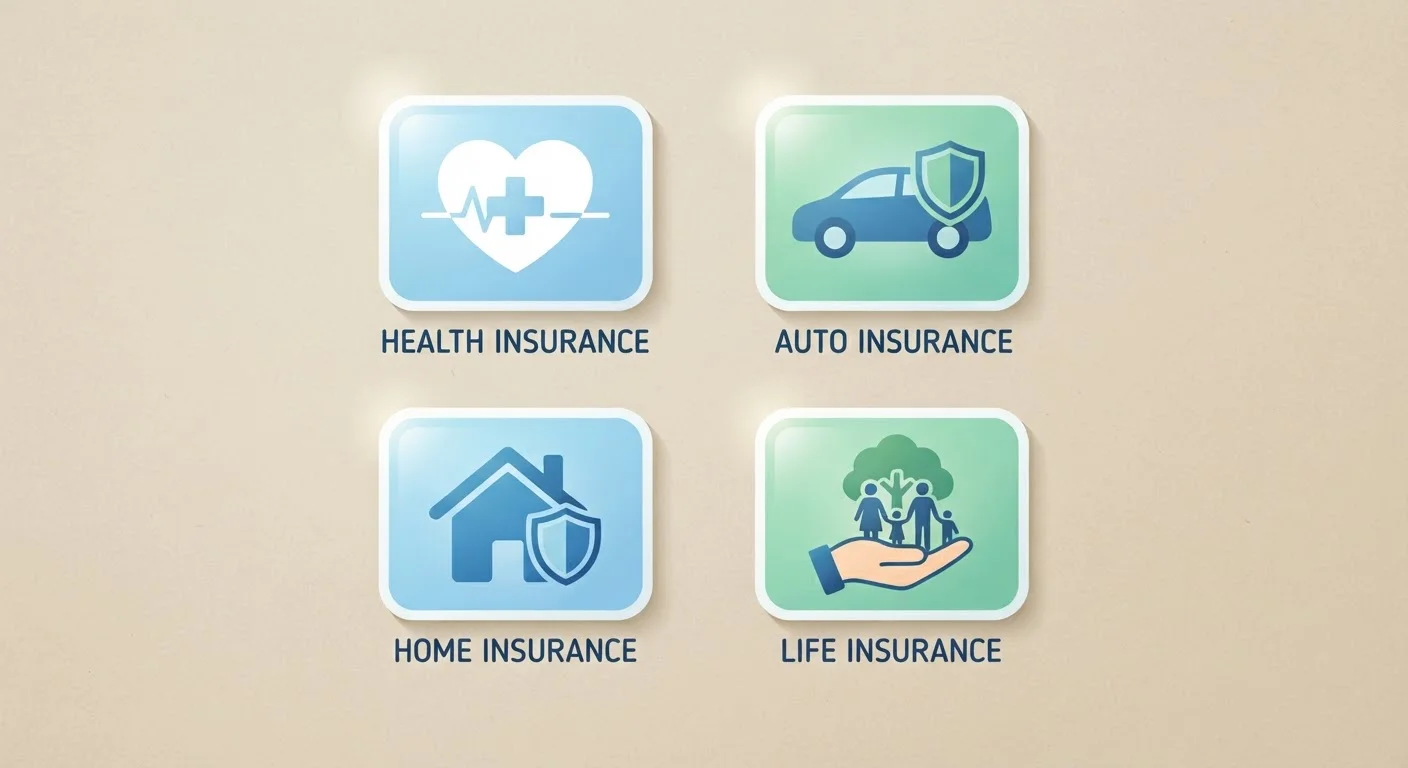
Most financial planners group personal insurance into four foundational categories: health, auto, home, and life. Together, they address the four biggest financial exposures most households face — medical costs, vehicle liability, property damage, and the economic impact of a death in the family. Understanding each one at a basic level is the starting point for making coverage decisions that actually fit your life.
This article is general educational information, not personalized insurance or financial advice. Coverage terms, costs, and requirements vary by state and insurer, so always review actual policy documents and consult a licensed agent for guidance specific to your situation.
Premium
The amount you pay — usually monthly or annually — to keep an insurance policy active, regardless of whether you file a claim.
Deductible
The amount you pay out of pocket on a claim before the insurance company starts covering costs. A higher deductible generally means a lower premium.
Coverage limit
The maximum dollar amount an insurer will pay for a covered loss. Any costs above that limit are your responsibility.
Liability coverage
Protection that pays for harm you accidentally cause to other people or their property. It does not cover your own losses.
Exclusion
A specific situation, event, or type of damage that a policy does not cover. Exclusions are spelled out in the policy document.
Beneficiary
The person or entity you name to receive a life insurance payout when you die. You can name multiple beneficiaries and specify how the benefit is divided.
Health Insurance
Health insurance helps pay for medical care — from routine checkups to emergency surgery. Without it, a single hospitalization can result in bills that overwhelm most household budgets. In the U.S., health insurance is offered through employers, government programs like Medicaid and Medicare, and marketplace exchanges established under the Affordable Care Act.
Key terms to know: your premium is what you pay each month to keep coverage active. Your deductible is what you pay out of pocket before the insurer starts sharing costs. A copay is a fixed fee you pay at the point of care (say, $30 for a doctor visit), while coinsurance is a percentage split between you and the insurer after the deductible is met.
Health plans also have an out-of-pocket maximum — once you hit that limit in a year, the insurer covers 100% of covered costs for the rest of that year. Networks matter too: in-network providers have negotiated rates with your insurer; going out-of-network often costs significantly more.
For a deeper look at these terms, see our plain-language insurance glossary.
Check Your Plan's Summary of Benefits
Every health plan is required to provide a Summary of Benefits and Coverage (SBC) — a standardized, plain-language document that outlines what the plan covers and what you'll pay. Reading the SBC before enrolling is one of the most efficient ways to compare plans side by side. Look for the out-of-pocket maximum and any exclusions that apply to care you use regularly.
Auto Insurance
Auto insurance is required by law in nearly every U.S. state. At minimum, most states mandate liability coverage — which pays for injuries and property damage you cause to others in an accident. It does not cover your own vehicle or injuries.
Beyond the legal minimum, drivers often carry additional coverages. Collision coverage pays to repair or replace your vehicle after a crash, regardless of fault. Comprehensive coverage handles non-collision events like theft, hail, or a falling tree. Uninsured/underinsured motorist coverage protects you if you're hit by a driver who has no insurance or insufficient coverage.
If you have a car loan or lease, your lender will almost certainly require both collision and comprehensive coverage. Once your vehicle is paid off and its value has dropped significantly, you may choose to reconsider those coverages — but that decision depends on your financial cushion and risk tolerance.
Minimum Coverage May Not Be Enough
State-required liability minimums are set as a legal floor, not as a recommended protection level. If you cause a serious accident, minimum coverage may be exhausted quickly, leaving you personally responsible for the remainder. Review whether your liability limits align with your financial exposure — an agent can help you assess this.
Home Insurance
Home insurance — formally called a homeowners policy — protects your property and finances in two broad ways: it covers physical damage to the structure and your belongings, and it provides liability protection if someone is injured on your property.
A standard homeowners policy typically covers damage from fire, windstorms, hail, and theft, but it usually excludes floods and earthquakes. If you live in a flood-prone area, a separate flood insurance policy — often purchased through the National Flood Insurance Program — is worth investigating.
Renters should note that a landlord's policy covers the building but not your personal belongings. Renters insurance fills that gap and is generally affordable.
If you carry a mortgage, your lender will require homeowners insurance. The coverage amount should generally reflect the cost to rebuild the home, not its market value — those two figures are often different. To understand how policy limits and exclusions work in practice, our first-timer's guide to reading an insurance policy walks through what to look for.
Life Insurance
Life insurance pays a benefit to your designated beneficiaries when you die. Its primary purpose is to replace income or cover obligations — like a mortgage or childcare costs — that your dependents would otherwise struggle to meet without you.
The two most common forms are term life and permanent life. Term life covers a specific period (say, 20 years) and pays out only if you die within that term. It's typically the more straightforward, lower-cost option for people who need coverage for a defined period. Permanent life insurance (which includes whole life and universal life) stays in force as long as premiums are paid and often includes a savings or investment component — though these policies are more complex and more expensive.
Not everyone needs life insurance. If you have no dependents and your debts wouldn't burden others, the need is less pressing. As your circumstances change — a new child, a mortgage, a spouse who relies on your income — the case for coverage strengthens.
For help thinking through your overall coverage picture, see our guide on evaluating your insurance needs from scratch.
Putting It All Together
Each of the four pillars covers a distinct category of risk. Health insurance guards against medical costs. Auto insurance manages liability and vehicle loss. Home insurance protects your property and shields you from liability. Life insurance supports the people who depend on you financially.
None of these are one-size-fits-all products. The right coverage levels, deductibles, and policy structures depend on your assets, income, family situation, and risk tolerance. The goal of this overview is to give you a working foundation — enough to understand what you're buying and what questions to ask.
When you're ready to go deeper, explore our Choosing Coverage hub for guidance on evaluating specific coverage types, or visit our Policy Essentials hub to understand how policy terms, limits, and claims actually work. A licensed insurance agent in your state can help you apply these concepts to your specific circumstances.
This article is for general informational and educational purposes only and does not constitute personalized insurance, financial, or legal advice. Coverage, costs, and legal requirements vary by state and insurer. Please consult a licensed insurance professional before making coverage decisions.