
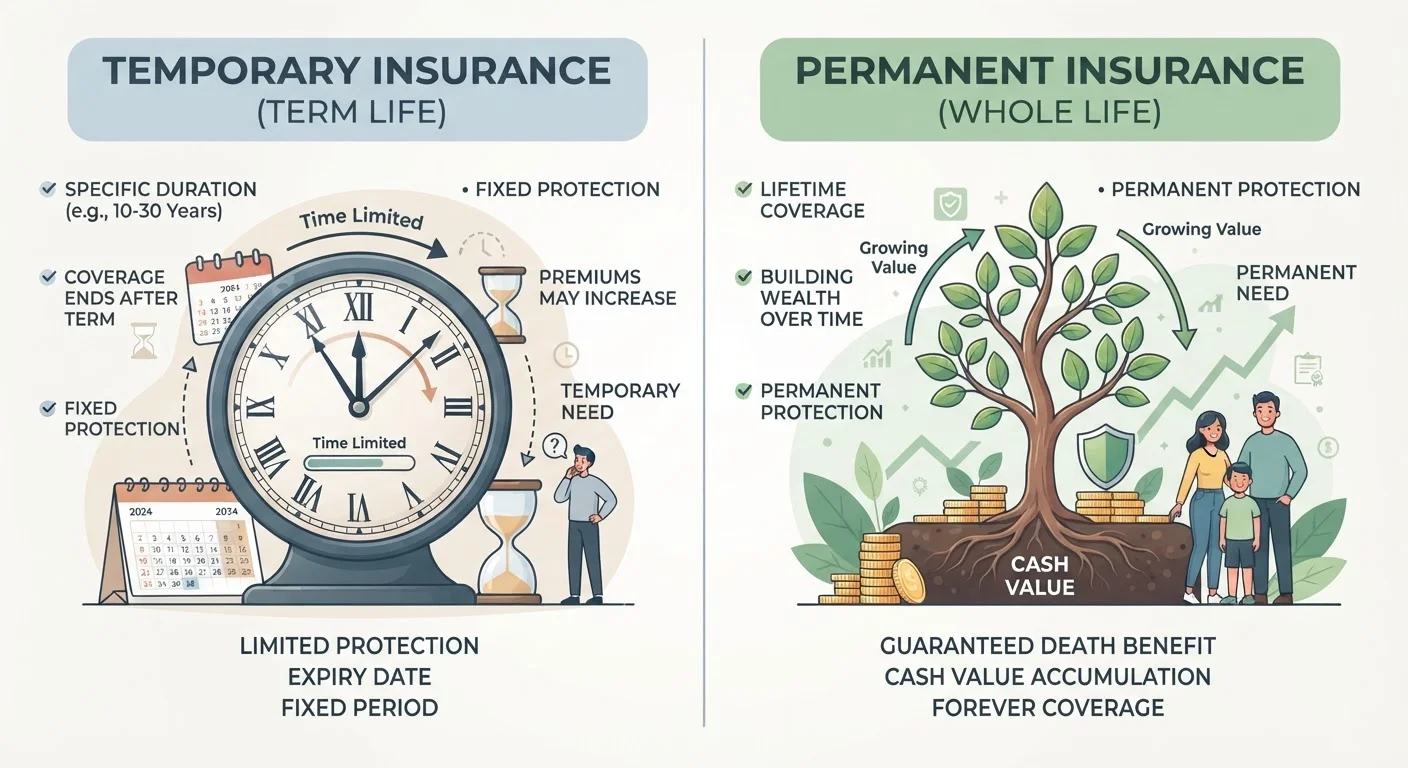
The Core Structural Difference
Term life and whole life insurance both pay a death benefit to your named beneficiaries when you die — but that's roughly where the similarity ends. The two products are engineered differently, priced differently, and designed to solve different financial problems.
Term life insurance covers you for a defined period — commonly 10, 20, or 30 years. If you die within that window, your beneficiaries receive the death benefit. If the term ends and you're still living, the coverage simply expires (unless you renew or convert, options that vary by policy). There is no accumulated value; you're paying purely for the protection itself.
Whole life insurance has no expiration date. As long as required premiums are paid, the policy stays in force for your lifetime. A portion of each premium contributes to a cash value account that grows at a rate set by the insurer. Policyholders can borrow against this cash value or surrender the policy for its accumulated value, subject to the terms and conditions of the specific policy.
Understanding these fundamentals is worth pairing with a broader look at policy language — the field guide to insurance policy terms breaks down concepts like riders and exclusions that affect both product types.
| Criterion | Term Life Insurance | Whole Life Insurance |
|---|---|---|
| Coverage duration | Fixed term (e.g., 10–30 years) | Lifelong (while premiums paid) |
| Premium cost | Lower for same death benefit | Significantly higher |
| Cash value | None | Accumulates over time |
| Death benefit certainty | Only if death occurs in term | Paid whenever death occurs |
| Policy complexity | Relatively simple | More complex structure |
| Flexibility | Some policies allow renewal or conversion | Cash value access via loans or surrender |
Cost, Value, and Trade-Offs
Premium cost is often the first place the structural difference becomes concrete. Because term insurance covers a limited window and builds no cash value, it typically costs considerably less than whole life for the same death benefit amount. A healthy adult in their 30s, for example, might pay a fraction of the whole life premium cost for equivalent term coverage — though actual rates depend entirely on the insurer, the applicant's health profile, and policy specifics.
Whole life's higher premium reflects two things: the certainty that the insurer will eventually pay a death benefit (since coverage doesn't expire), and the cost of building the cash value component. That cash value grows tax-deferred under current U.S. tax law, but accessing it through loans or withdrawals has its own implications that vary by policy and tax situation.
~80%
Life insurance policies sold that are term
According to LIMRA industry data, term life has consistently represented the majority of individual life insurance policies sold by count in the U.S.
5–15×
Typical premium difference for same death benefit
Insurance industry guides commonly illustrate that whole life premiums can run several multiples higher than term premiums for equivalent face amounts, depending on age and health.
It's also worth noting that underwriting plays a role in what you're offered and at what cost for both product types. The underwriting process explained describes how insurers assess risk before issuing any policy.
Neither option is objectively superior. The right structure depends on your financial obligations, how long you need coverage, and what role — if any — you want life insurance to play in longer-term planning. These are decisions where working with a licensed insurance professional makes a meaningful difference.
This article is for general informational and educational purposes only. It does not constitute personalized financial, insurance, or legal advice. Coverage terms, premiums, and eligibility vary by insurer and individual circumstances. Please consult a licensed insurance agent or financial adviser before making decisions about your coverage.
Common Misconceptions Worth Addressing
One frequent assumption is that whole life is always the more sophisticated or responsible choice simply because it's more expensive. That framing misses the point. A term policy sized appropriately for your actual needs may provide more meaningful protection per premium dollar during the years your dependents are most financially vulnerable.
Conversely, some people dismiss whole life entirely without considering whether the permanent structure fits a specific planning goal. The cash value feature, for instance, may appeal to those who want a disciplined long-term savings element bundled with coverage — though it's not a substitute for dedicated investment or retirement accounts and comes with its own costs and trade-offs.
The article on life insurance misconceptions covers several of these assumptions in depth, including the common belief that employer-provided coverage is sufficient on its own.
A useful cross-category comparison: if you've ever navigated the liability vs. comprehensive auto coverage decision, you already know that different coverage structures exist because different risks require different solutions. Life insurance works the same way.
When you're ready to evaluate your options more broadly, the Choosing Coverage hub offers additional guides across insurance types to help you build a clearer picture of your needs.
Policy Terms Vary Significantly
The features described here reflect general structural characteristics of term and whole life insurance — not any specific insurer's product. Actual cash value growth rates, loan provisions, renewal options, and exclusions differ across policies and providers. Always read the full policy document and ask your insurer or agent to explain any terms you're unsure about before purchasing.