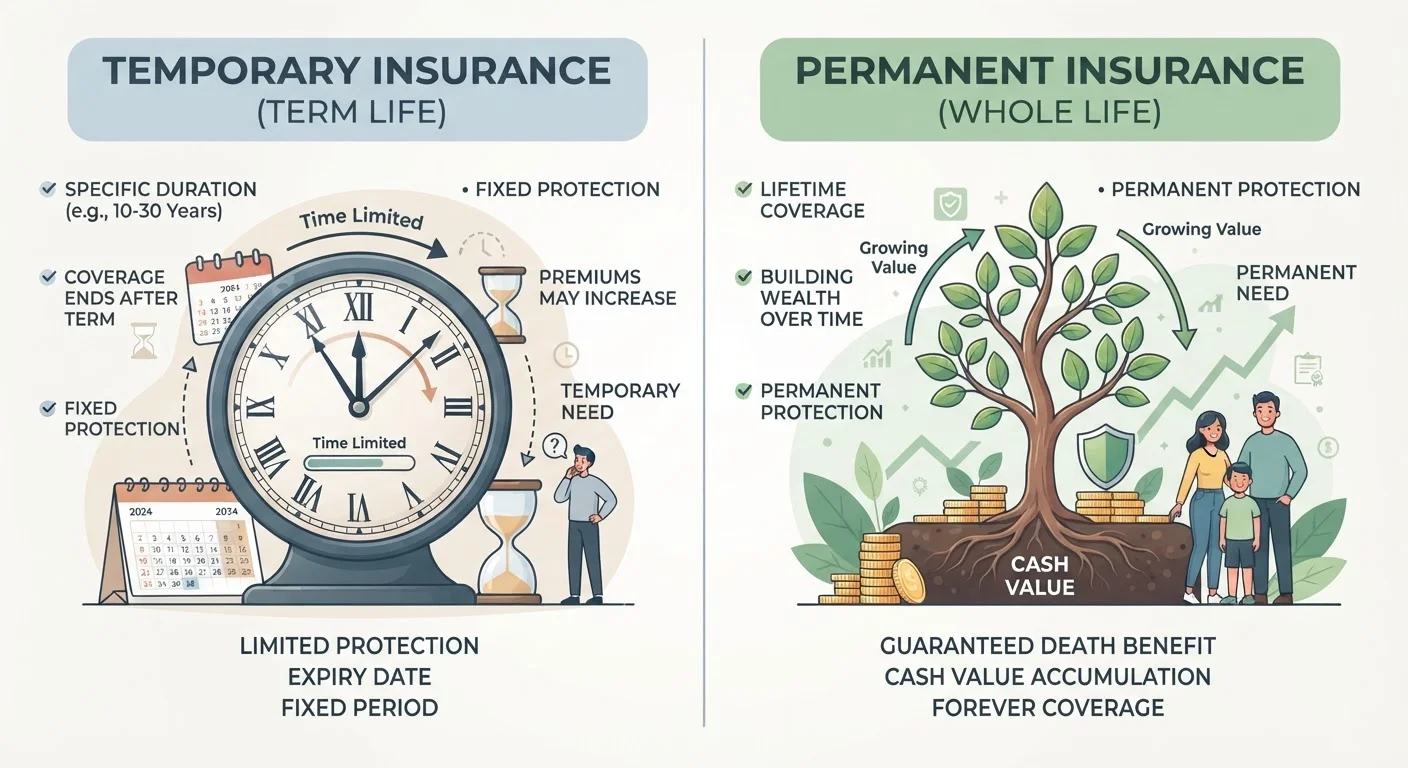

How Each Policy Is Structured
The most fundamental difference between term and whole life insurance is duration. A term life policy covers a defined period — commonly 10, 20, or 30 years. If the insured person dies during that window, the insurer pays a death benefit to the named beneficiaries. If the term expires and the insured is still living, the coverage simply ends (though some policies offer renewal or conversion options at additional cost).
Whole life insurance, by contrast, is designed to remain in force for the insured's entire life. As long as premiums are paid, coverage does not lapse due to age or time. Whole life also includes a cash-value component — a portion of each premium goes into a reserve that grows at a guaranteed, tax-deferred rate set by the insurer. Policyholders can borrow against this cash value or surrender the policy for its accumulated amount, though doing so has financial and tax implications worth discussing with a licensed professional.
For a deeper look at how these structural differences play out in practice, see Term Life vs. Whole Life Insurance: Understanding the Structural Difference.
| Criterion | Term Life | Whole Life |
|---|---|---|
| Coverage duration | Fixed term (e.g., 10–30 years) | Lifetime (while premiums paid) |
| Premium cost | Lower for same benefit amount | Significantly higher |
| Cash value | None | Accumulates over time |
| Premium stability | Level during term; may rise at renewal | Level for life |
| Complexity | Simple structure | More components to understand |
| Payout certainty | Only if death occurs in term | Guaranteed eventually |
Cost Differences and What Drives Them
Premium cost is where the two types diverge most sharply for most buyers. Term life premiums are calculated primarily on the probability of dying within the policy term, your age, health status, and the benefit amount. Because most term policyholders outlive their coverage period, insurers carry less risk per policy — which keeps premiums lower.
Whole life premiums are higher for several reasons. The insurer is guaranteeing a payout at some point (since everyone dies eventually), and it is also funding the cash-value component. Premiums are typically level for life, meaning they do not increase as you age, which provides predictability but means committing to a higher ongoing cost from the outset.
~$30/mo
Typical monthly term premium for healthy 30-year-old
LIMRA industry data indicates a healthy 30-year-old can often obtain a 20-year, $500,000 term policy for roughly $25–$35 per month, though individual quotes vary.
3–5×
Approximate whole life premium multiple vs. term
Insurance industry sources generally indicate whole life premiums run several times higher than term premiums for equivalent death benefit amounts, depending on age and health.
Underwriting plays a significant role in what either policy actually costs you as an individual. Factors like age, tobacco use, family medical history, and occupation all affect the premium you are quoted. To understand how insurers arrive at those numbers, learn how underwriting decisions affect the coverage you're offered.
Trade-offs Worth Knowing Before You Decide
Neither policy type is a clear winner for every situation — both involve genuine trade-offs.
- Term's limitation: If you outlive your policy and still want coverage, renewing or buying a new policy at an older age can be expensive, and health changes may affect your eligibility.
- Whole life's limitation: The cash-value growth rate is typically modest compared to other long-term savings vehicles. You are paying a premium for the insurance guarantee, not primarily for investment performance.
- Conversion options: Some term policies allow conversion to a permanent policy within a set window, without new medical underwriting. This can be worth checking when you first buy a term policy.
- Policy loans: Borrowing against whole life cash value is not free money — unpaid loans reduce the death benefit paid to your beneficiaries.
One Type Doesn't Replace the Other
Some households carry both types at once — a term policy for peak coverage during working years, and a smaller whole life policy for final expenses or estate planning purposes. This layered approach is common, though whether it makes sense depends entirely on individual financial circumstances. A licensed insurance professional can help you assess what combination, if any, fits your situation.
If some of the terminology here feels unfamiliar, the Insurance Terms You'll Actually Encounter glossary defines common policy language in plain English. You can also explore the broader Coverage Types hub to see how life insurance fits within the wider insurance landscape.
This article is for general informational purposes only and does not constitute personalized financial, insurance, or legal advice. Coverage terms, costs, and eligibility vary by provider and state. Consult a licensed insurance agent or financial adviser before making decisions about your own coverage.