
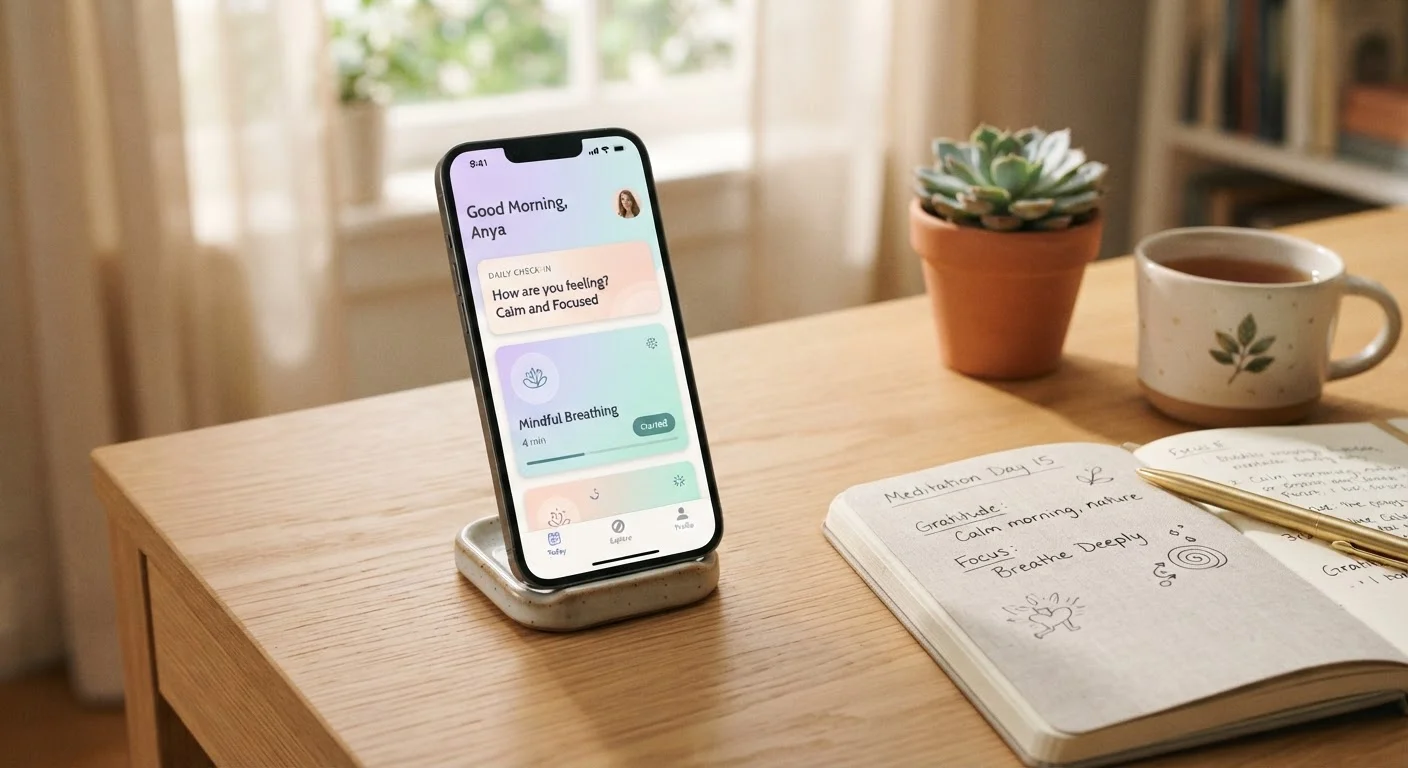
Why Mental Health Apps Have Gone Mainstream
More Americans are turning to smartphones for mental wellness support — and the numbers reflect it. App stores now host hundreds of tools targeting anxiety, sleep, mood, and stress. The appeal is straightforward: they're available any time, require no appointment, and carry none of the stigma that still surrounds seeking professional help. For a look at how that stigma operates, see our piece on common myths about mental health.
Many apps draw on established psychological frameworks — particularly cognitive behavioral therapy (CBT) and mindfulness-based approaches — to deliver guided exercises, journaling prompts, and breathing techniques. This gives them a legitimate foundation, even if their effectiveness varies by individual and use case.
10,000+
Mental health apps available in major app stores
According to a report by IQVIA Institute for Human Data Science, tens of thousands of mental health and wellness apps are available globally, though evidence quality varies widely.
~20%
U.S. adults experiencing mental illness annually
The National Institute of Mental Health estimates roughly one in five American adults lives with a mental illness each year, highlighting the scale of unmet support needs.
What Mental Health Apps Can Realistically Offer
At their best, these tools do several things well:
Low barrier to entry for everyday wellness habits
Apps eliminate common obstacles — cost, scheduling, travel — that prevent many people from accessing any form of mental health support. This accessibility can be particularly valuable for those in underserved areas.
Structured skill-building between therapy sessions
Apps grounded in CBT or mindfulness provide exercises that reinforce skills introduced in professional therapy, helping users practice techniques in real-world moments of stress.
Mood and pattern tracking over time
Consistent self-monitoring through journaling or check-ins can surface patterns — triggers, sleep correlations, emotional cycles — that might otherwise go unnoticed and can inform conversations with a provider.
On-demand tools for acute stress moments
Breathing exercises and grounding techniques available instantly through an app can offer practical relief during moments of anxiety, providing a concrete first response.
Reduced stigma and a private entry point
For people hesitant to seek formal help, an app offers a private, judgment-free way to start engaging with mental wellness concepts and build comfort around the topic.
Apps shine as habit-formation tools. Consistent journaling or a nightly wind-down routine can meaningfully reduce low-level stress over time. For someone who isn't sure where to start, a personal mental wellness audit can help clarify which areas an app might usefully support.
Where Apps Fall Short — And Why It Matters
Understanding limitations isn't a reason to dismiss these tools; it's a reason to use them wisely.
Cannot diagnose or clinically treat mental health conditions
Apps are not licensed medical devices for diagnosis or treatment. Using one in place of professional evaluation for persistent symptoms can delay appropriate care and potentially worsen outcomes.
Evidence quality varies significantly across products
Many apps claim clinical grounding without peer-reviewed validation. A 2019 review published in npj Digital Medicine found that most mental health apps lack high-quality evidence for their effectiveness.
Privacy and data security risks
Mental health apps collect sensitive personal data, and policies on storage, sharing, and third-party access vary widely. Some apps have faced scrutiny for sharing user data with advertisers.
Risk of substituting apps for necessary professional care
Individuals experiencing clinical depression, anxiety disorders, trauma, or other significant conditions need licensed care. Relying on an app alone risks undertreatment of conditions that respond well to professional intervention.
Engagement tends to drop off rapidly over time
Research on digital health tools consistently shows high early adoption but steep drop-off in sustained use — meaning the long-term benefit many users anticipate may not materialize without deliberate commitment.
The distinction between app-based support and clinical care is significant. If you're uncertain whether what you're experiencing warrants professional attention, reviewing the difference between therapy, coaching, and counseling can help you decide on a next step. Apps do not replace that continuum of care.
When to Seek Professional Support Instead
If you're experiencing persistent sadness, anxiety that interferes with daily life, thoughts of self-harm, or symptoms that worsen over time, an app is not the appropriate primary resource. Please reach out to a licensed mental health professional or contact the 988 Suicide and Crisis Lifeline by calling or texting 988. Apps may complement care but should not delay it.
Getting the Most Out of What Apps Offer
A few practical principles help separate useful engagement from digital noise:
- Match the tool to the goal. A sleep-focused app won't resolve work-related anxiety on its own. Be specific about what you want to address.
- Check the evidence base. Look for apps that reference established methods — CBT, dialectical behavior therapy (DBT), or mindfulness-based stress reduction — rather than proprietary, unvalidated approaches. Our mental wellness glossary explains these frameworks in plain language.
- Review the privacy policy. Mental health data is sensitive. Understand what is collected, stored, and shared before entering personal information.
- Use it alongside connection, not instead of it. Research consistently shows that social support is a powerful buffer for mental health challenges — something no app fully replicates. For more on this, see the underrated role of social connection.
This article is for general informational purposes only and does not constitute medical or mental health advice. If you are experiencing significant distress or mental health symptoms, please consult a licensed mental health professional.