Three Terms, Three Meanings
Walk into any fitness class or scroll through a wellness feed and you'll see flexibility, mobility, and stretching used as if they mean the same thing. They don't — and confusing them can lead to training gaps that leave you sore, stiff, or more injury-prone than you'd like.
Flexibility
The passive ability of a muscle or soft tissue to lengthen when an external force is applied. It reflects how far a muscle can be stretched, not whether you can actively control that range.
Mobility
The active ability to move a joint through its full intended range of motion using your own muscular control. Good mobility means you can both reach and stabilize a position without assistance.
Stretching
A broad category of techniques — including static holds, dynamic movements, and assisted methods — used to increase or maintain the length and pliability of muscles and connective tissue.
Static Stretching
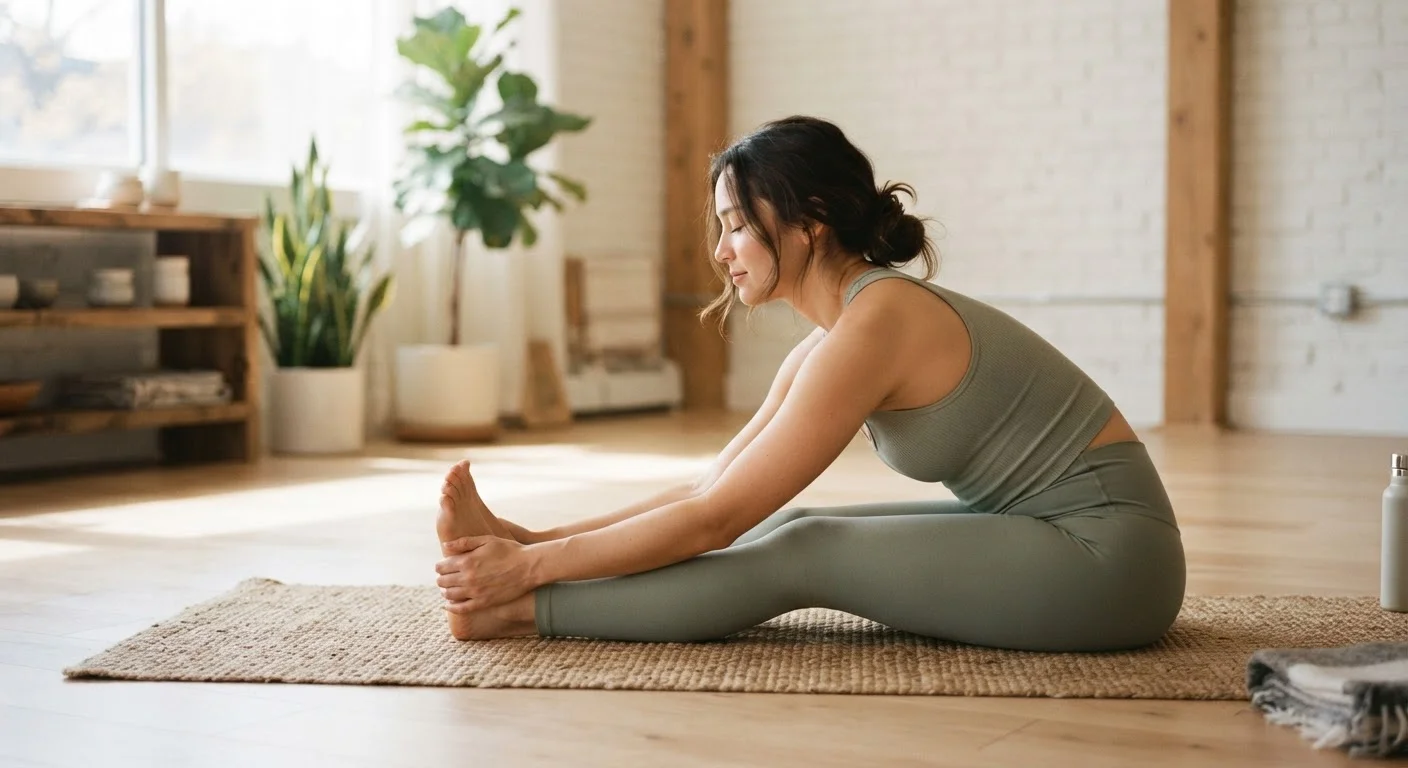
Holding a stretch position for a set duration, typically 20–60 seconds, without movement. Commonly used to improve or maintain flexibility after physical activity.
Dynamic Stretching
Controlled, rhythmic movements that take a joint through its range of motion repeatedly. Often used in warm-ups to prepare muscles and joints for activity.
Range of Motion (ROM)
The extent of movement possible at a given joint, measured in degrees. ROM can be passive (assisted) or active (under your own control) and varies by joint and individual.
Flexibility refers to the passive capacity of a muscle or muscle group to lengthen. It's a tissue property — how far your hamstring can stretch when an outside force (gravity, a strap, a partner) assists the movement. High flexibility doesn't automatically mean you can use that range in everyday life or during exercise.
Mobility is your ability to actively move a joint through its full range of motion under your own muscular control. Where flexibility is passive, mobility is active. A person can be quite flexible yet have poor mobility if their muscles and nervous system can't reliably access or stabilize that range.
Stretching is the practice — the collection of techniques (static holds, dynamic movement, proprioceptive neuromuscular facilitation) used to influence flexibility and, over time, support mobility. Think of stretching as a tool, not a destination.
Why the Difference Matters for Your Movement Goals
Knowing which quality you're actually working on helps you choose the right approach. If your goal is to move better day-to-day — bending to tie your shoes, reaching overhead, getting up from the floor — mobility is your primary target. Mobility training typically involves controlled movement through a joint's range, often with bodyweight resistance.
| Primary target of static stretching | Muscle and connective tissue length (flexibility) |
| Primary target of mobility drills | Active, controlled joint range of motion |
| Recommended static hold duration | 30–60 seconds per stretch (American College of Sports Medicine general guidelines) |
| Best time for static stretching | Post-exercise or as a stand-alone practice (Current exercise science consensus) |
| Best time for dynamic stretching | Before exercise, as part of a warm-up |
| Flexibility gains maintained by | Consistent, ongoing practice (Sports medicine literature) |
If you're recovering from prolonged sitting or want to reduce muscle tension, flexibility work (particularly static stretching held for 30–60 seconds) has a role. Research published in sports medicine literature consistently shows that regular static stretching can increase range of motion over weeks of practice, though gains are largely reversed if you stop.
Pairing both approaches tends to produce more durable results than either alone. For practical ideas on weaving movement into a busy schedule, see Movement Snacks: Fitting Exercise Into a Packed Day. And if you've been told you "just aren't flexible," it's worth checking Common Fitness Myths That Might Be Holding You Back before accepting that as fixed truth.
Choosing the Right Approach
A few principles help guide sensible choices:
- Static stretching (holding a position) is generally best placed after exercise, when muscles are warm, or as a stand-alone wind-down practice. Performing long static holds immediately before high-intensity activity may temporarily reduce power output, according to current exercise science guidance.
- Dynamic stretching — controlled movements through a joint's range — is well-suited to warm-ups because it prepares muscles and joints without that temporary performance trade-off.
- Mobility drills (think hip circles, controlled articular rotations, or slow deep squats with a pause) train the nervous system to actively own a range, not just passively reach it.
Joint-friendly movement forms like yoga and tai chi blend all three elements. For a broader look at low-impact options, Low-Impact Exercise Options Worth Knowing About covers a range of approaches and what each is genuinely good for.
Mobility Declines Without Use
Joint mobility tends to decrease with prolonged inactivity or repetitive single-plane movement — common patterns in desk-based work. This isn't permanent; consistent, varied movement practice can help restore usable range over time. The key word is consistent: occasional stretching provides far less benefit than a regular routine.
This article is for general informational purposes only and does not constitute medical or physical therapy advice. If you have an injury, chronic condition, or specific movement concern, consult a qualified healthcare professional or licensed physical therapist before beginning any new movement practice.