What Makes an Expense Fixed or Variable
Every dollar leaving your account falls into one of two behavioral categories: it either stays consistent regardless of what you do, or it shifts depending on your choices. That distinction — fixed versus variable — is the foundation of sound budgeting, not just a textbook classification.
Fixed expenses are costs that remain the same amount each billing cycle. Your rent or mortgage payment, car loan installment, insurance premium, and subscription services with flat monthly fees are all fixed. They don't change because you had a busy month or skipped a meal out. You've essentially pre-committed to these amounts.
Variable expenses fluctuate based on usage, decisions, or circumstances. Groceries, gas, dining out, clothing, and utility bills all vary from month to month. How much you spend here depends on your behavior, the season, or life events — making them the most dynamic part of any budget.
For a quick-reference breakdown with everyday examples, see Fixed vs. Variable Expenses: A Budgeter's Reference.
| Criterion | Fixed Expenses | Variable Expenses |
|---|---|---|
| Monthly amount | Same every month | Changes month to month |
| Examples | Rent, car loan, insurance | Groceries, gas, dining out |
| Ease of predicting | Very easy — amount is set | Requires tracking and averaging |
| Short-term flexibility | Low — usually contractual | High — changes with behavior |
| Best budgeting method | List exact known amounts | Average past 2–3 months |
| Primary savings lever | Renegotiate or eliminate periodically | Reduce usage or frequency consistently |
Why the Distinction Matters for Your Budget
Most budget failures don't happen because people lack discipline — they happen because the budget was built on faulty assumptions. Treating all expenses the same is one of the most common mistakes. When you don't separate fixed from variable costs, two problems emerge.
First, you can't accurately calculate your true financial floor — the minimum you must earn each month to meet all obligations. Fixed expenses define that floor. If your fixed costs total $2,400 a month, that number is non-negotiable regardless of what else happens.
Second, you lose visibility into where flexibility actually exists. Variable expenses are your real adjustment levers. You can't easily renegotiate a lease mid-term, but you can make different choices at the grocery store or skip a restaurant this week. Small, consistent adjustments to variable spending are what build savings and reduce debt over time.
~33%
Average share of income spent on housing alone
The U.S. Bureau of Labor Statistics Consumer Expenditure Survey consistently finds housing is the largest single fixed expense for American households.
~15%
Typical share of spending on food
Food — split between groceries and dining — is one of the largest variable expense categories for most U.S. households, per BLS data.
It's also worth acknowledging the gray area: some expenses are partially fixed. Utilities, for example, have a base service fee (fixed) layered on top of usage-based charges (variable). Treating these as purely one or the other leads to miscalculation. Budget these using a realistic average drawn from past bills.
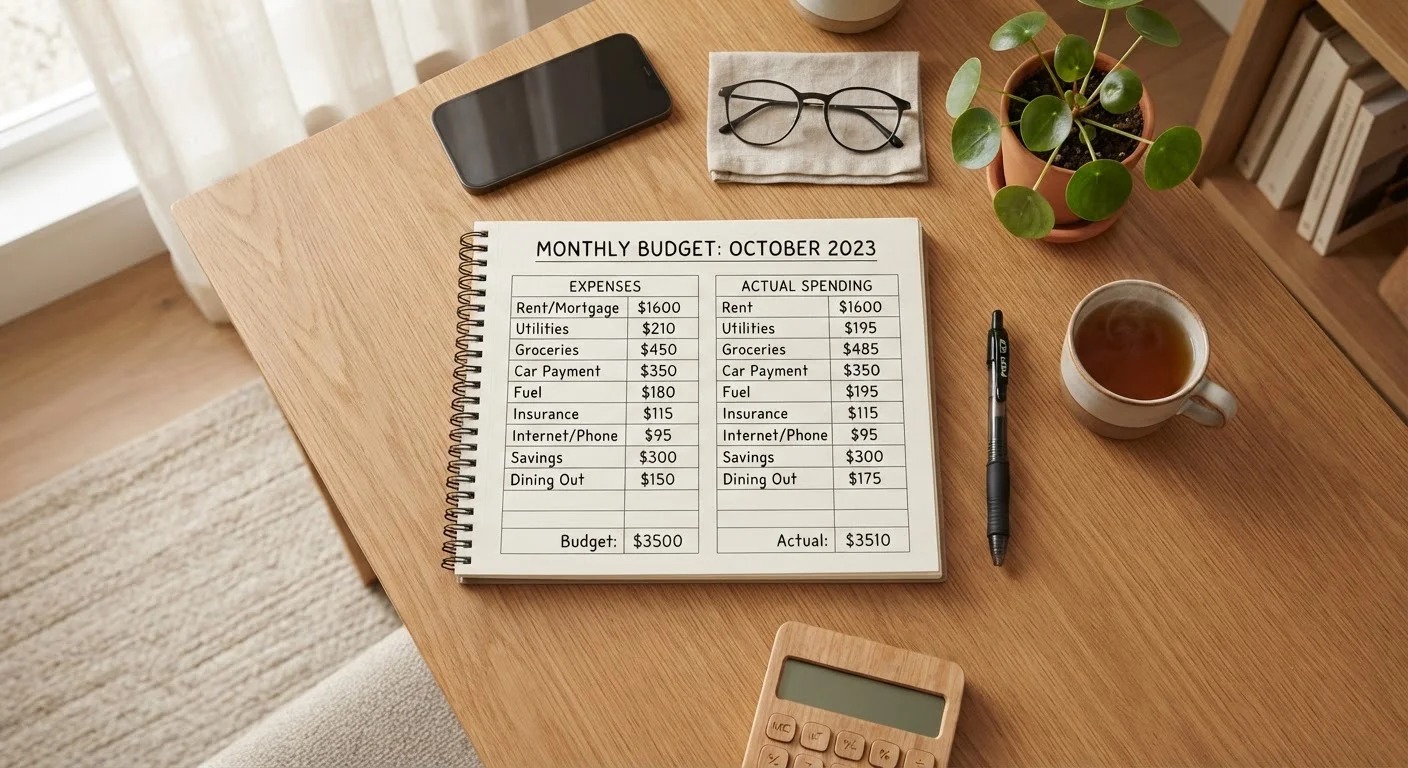
This kind of clarity is what makes a monthly budget review genuinely useful — you're checking whether variable spending drifted and whether fixed costs changed.
Putting the Framework Into Practice
Once you've labeled your expenses correctly, the budgeting process becomes more structured and less stressful. A practical approach:
- List all fixed expenses first. These are your committed costs. Add them up to find your monthly floor.
- Track variable expenses by category. Pull three months of statements to find realistic averages — not aspirational ones.
- Identify variable categories with room to flex. Discretionary spending like dining, entertainment, and shopping offers the most adjustment potential without affecting your core quality of life.
- Revisit fixed expenses periodically. Insurance premiums, subscription bundles, and phone plans may be renegotiable or replaceable — just not month-to-month.
If your income isn't consistent, this framework is especially valuable. The Irregular Income and Budgeting guide explores how to apply this thinking when your paycheck varies.
And if you've been putting off budgeting altogether, common budgeting myths may be what's holding you back — not your actual financial situation. The fixed-vs-variable framework is intentionally simple: it works regardless of income level, and it requires no special tools to start.
Semi-Variable Expenses Need Their Own Category
Some costs don't fit neatly into either bucket. Utility bills, for example, carry a fixed base charge plus variable usage costs. Medical expenses are another — predictable for some, unpredictable for others. When building your budget, create a separate line for these hybrid expenses and use a rolling average from past statements to set a realistic monthly estimate. Don't force them into either category at the expense of accuracy.
This article is for general informational and educational purposes only and does not constitute personalized financial advice. Consult a qualified financial professional for guidance specific to your situation.