
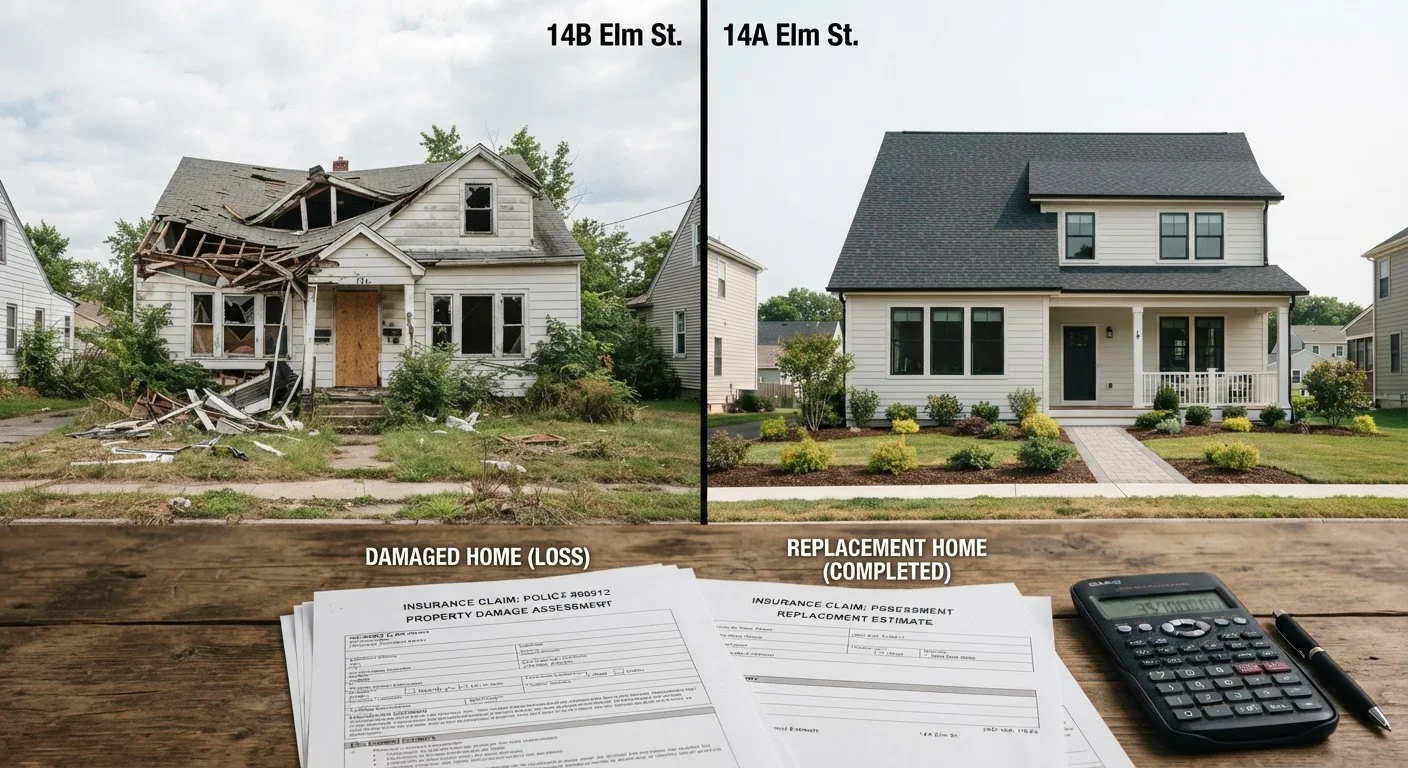
How Each Valuation Method Is Calculated
When you file a property insurance claim, one of the most consequential details in your policy is how your insurer calculates what it owes you. Two formulas dominate: Actual Cash Value (ACV) and Replacement Cost Value (RCV). They start from the same place — the cost to replace the damaged item — but quickly diverge.
ACV formula: Replacement Cost minus Depreciation. Depreciation accounts for an item's age, wear, and expected remaining useful life. A roof with a 20-year lifespan that is 10 years old has used half its value. If a new roof costs $20,000, the ACV payout might be closer to $10,000 — before your deductible.
RCV formula: The full cost to repair or replace the item with one of like kind and quality at today's prices. Depreciation is not subtracted. That same roof scenario would yield a payout closer to $20,000, minus your deductible.
Insurers calculate depreciation using factors like age, condition, and industry-standard depreciation schedules. Some depreciation is considered non-recoverable even under RCV policies, particularly for items with obvious prior wear. Always ask your insurer or agent which depreciation factors apply to your specific coverage.
| Criterion | Actual Cash Value (ACV) | Replacement Cost Value (RCV) |
|---|---|---|
| Payout formula | Replacement cost minus depreciation | Full replacement cost, no depreciation deducted |
| Out-of-pocket gap after a claim | Potentially significant | Minimal, if repairs are completed |
| Typical premium cost | Lower | Higher |
| Best for older items | Unfavorable — heavy depreciation hit | Favorable — age is not penalized |
| Payment timing | Single lump-sum payment | Often two-step: ACV first, remainder after repairs |
| Common policy types | Basic/standard homeowners, renters, auto | Upgraded homeowners, renters endorsements |
The Real-World Gap Between ACV and RCV
The math above might seem abstract, but the dollar gap becomes very real after a major loss. Consider a living room damaged by a burst pipe. A five-year-old 65-inch television, a sofa, and hardwood flooring could easily total $8,000 to replace at current retail prices. Under ACV, after applying standard depreciation schedules, a policyholder might receive $3,500 to $4,500 — leaving a $3,500-plus shortfall to cover out of pocket.
~40%
Typical depreciation on a 10-year-old roof
Standard industry depreciation schedules often apply 3–5% per year to roofing materials, meaning a decade-old roof may be valued at roughly 50–60% of replacement cost under ACV.
$3,000+
Potential ACV vs. RCV gap on a single room
For a room with moderately aged furnishings and flooring, the difference between an ACV payout and full replacement cost can easily exceed several thousand dollars.
This gap is why the choice of valuation method matters so much when you first purchase or renew a policy, not just when disaster strikes. For a broader look at how valuation fits alongside your coverage limits, see our guide on coverage limits, ACV, and RCV.
What 'Recoverable Depreciation' Means
Under an RCV policy, the portion of your payout withheld until repairs are completed is called recoverable depreciation. It is not lost — it is held back to confirm you actually repair or replace the item. Once you submit receipts or contractor invoices, the insurer releases that amount. If you never make the repairs, you typically forfeit that portion of the claim.
One important nuance: many RCV policies follow a two-step payment process. The insurer first pays the ACV amount so you have funds immediately. Once you complete the repairs or replacement and submit proof, the insurer releases the remaining recoverable depreciation. If you delay repairs or choose not to replace an item, you may only receive the ACV portion.
This article is for general informational and educational purposes only. It is not personalized insurance, financial, or legal advice. Coverage terms, exclusions, and calculations vary by policy, insurer, and state. Always read your policy documents in full and consult a licensed insurance agent or adviser for guidance specific to your situation.